Editor’s note: David Skinner, chef and owner of Kemah’s celebrated eculent and Ishtia restaurants, returns to CultureMap to share his account of his birthday dinner at Noma in Copenhagen, a pioneering culinary destination that's widely considered one of the world's best restaurants. Read on for how his experience at Noma's return to Copenhagen compares to his experience dining at its pop-up in Los Angeles that took place earlier this summer. Take it away, David.
I celebrated turning 62 at Noma in August, and the second course, an artichoke on its stalk, looked familiar. So did the turkey tail mushrooms and the chawanmushi in its giant eggshell.
I'd eaten all of them a few months earlier at Noma's pop-up in Los Angeles, where I came away thinking the traveling editions were better than the original. Copenhagen, on its third night back home, was my chance to find out if I was right.
Noma is one of my favorite restaurants in the world — for its creativity, its ingredients and the dedication of its staff — so I hold it to the highest bar. This version has a lot to prove, and Pablo Soto, who ran the Los Angeles residency, now leads the kitchen with head of research and development Mette Brink Søberg.
Noma asked Michelin to drop its three stars until the new team has been open long enough to earn them, and the old three seasons of Noma has given way to a menu that changes monthly. At nearly $1,000 a head I was expecting to be wowed.
The setup
Arriving at Noma is still one of the great entrances in dining. Diners walk a long concrete path through waist-high meadow grasses and coneflowers, past the glass greenhouses and a giant red-capped mushroom balloon (the same one that greeted guests in Los Angeles), toward a cluster of low buildings at the edge of the lake. On a gray August afternoon, it felt more like visiting a farm than a restaurant.
Dinner ran 22 courses, plus a birthday surprise, at 4,500 Danish kroner (about $690) per person. The wine pairing adds 2,000 kroner (about $305), so the all-in number lands near $1,000 before tip. That's a full third less than Los Angeles, which charged $1,500 including everything. Keep that in mind when I get to the wine.
The highlights
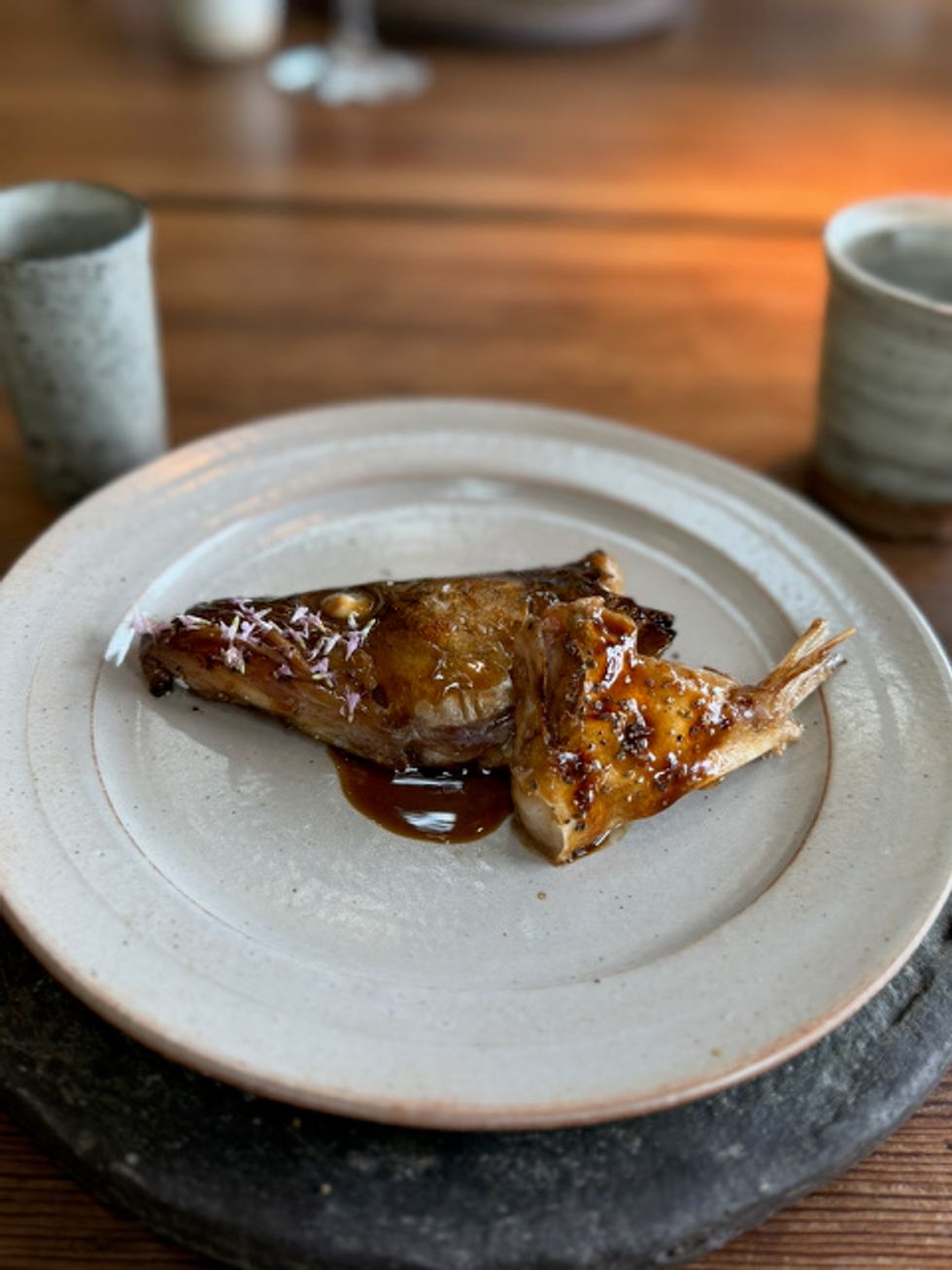
The pike perch head. My favorite dish of the night. The head and collar came perfectly roasted and lacquered in an unctuous, slightly sweet fish sauce. The glaze left my fingers sticky in the most delicious way, and I licked every one of them clean. I wanted more.
The crab. A single brown crab claw, roasted, spiced, and brushed with egg, tucked into glossy sheets of kelp. It was great, and I wanted more. But it fell short of the pink pepper Dungeness that opened the meal in Silver Lake.
The chawanmushi. Pulled king crab, bright fava beans and a generous spoon of caviar over a silky custard, served in an ostrich egg. It was nearly the same dish I'd had in Los Angeles, where it came in an emu egg with sea urchin, and it was one of the best bites of the night.
My other two favorites, you may notice, were dishes I'd already eaten in Los Angeles. Hold that thought.
Reruns from Los Angeles
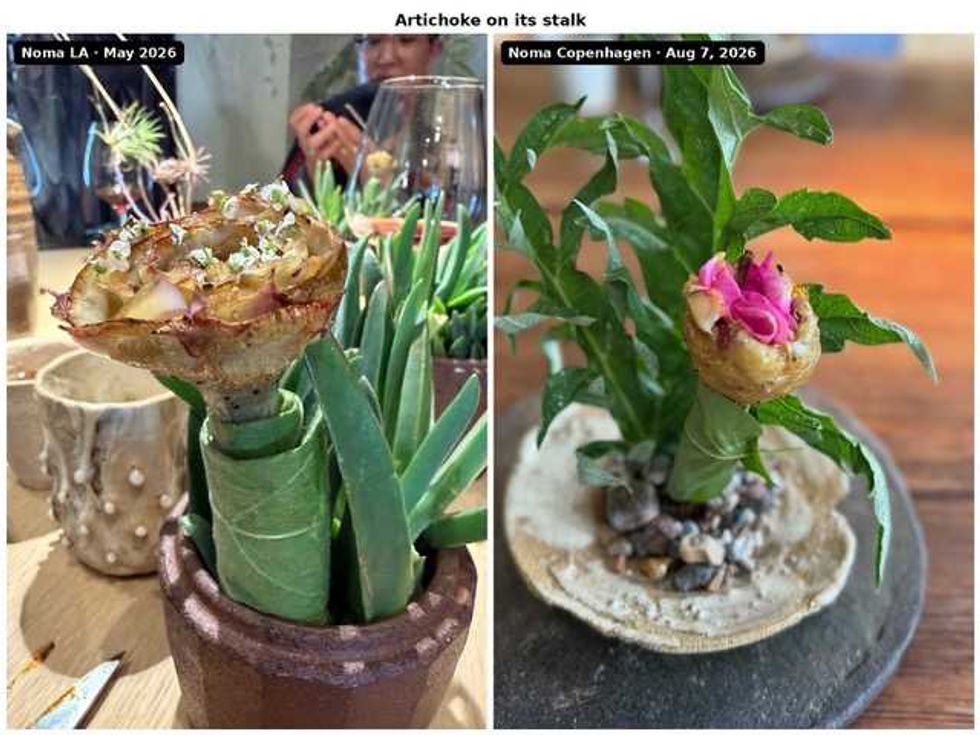
Anyone who ate in Silver Lake this spring would have recognized several dishes on the Copenhagen menu. In Los Angeles, a crab dumpling arrived tucked inside a daylily. In Copenhagen, the daylily returned on its own, lacquered and standing on its stalk, the stem held upright in beeswax. Los Angeles served a quiet ragout of California botanicals. Copenhagen served a summer ragout under black truffle and nasturtium flowers.
In Los Angeles, morels rested on a bed of turkey tail mushrooms, and that was the dish I called oversalted. In Copenhagen, the turkey tails came back with fir sprigs, a mushroom broth hidden below them. The artichoke came back on its stalk, trading the kelp mole for wild rose petals.
The ferns came back, too. In Silver Lake, you snipped open a fern bundle to find a chocolate fortune cookie. In Copenhagen, a grasshopper æbleskive simply arrived on a bed of ferns. The chawanmushi was basically the same dish in both cities, served in a giant eggshell with a spoon of caviar: emu in Los Angeles, ostrich in Copenhagen. Only the shellfish changed, from sea urchin to king crab. Even the barley koji pancake returned, this time in a completely different dessert. And crab bookended the experience on both continents.
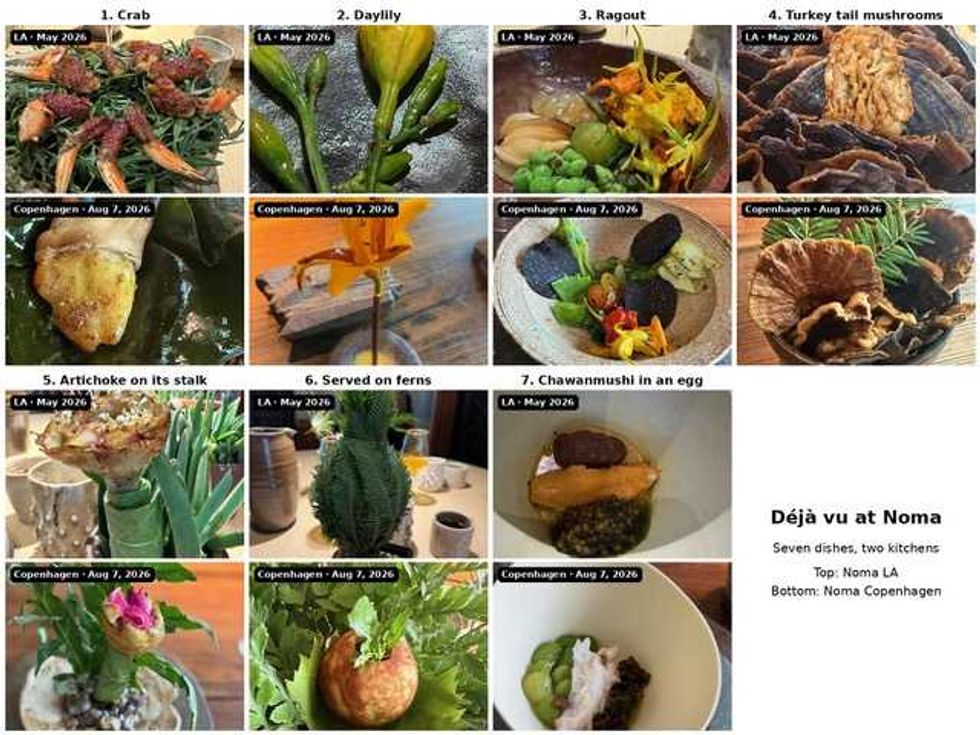 Same idea, two kitchens: Noma LA in May (top) and Noma Copenhagen on Aug. 7 (bottom). Left to right: crab, daylily, ragout, turkey tail mushrooms, artichoke on its stalk, ferns, custard in an egg.Photos by David Skinner.
I would have been fine with the repeats if they had improved on the originals. They didn't. Each one was a little less vivid than the version I'd eaten in Los Angeles a few months earlier. And for a kitchen that had just rebuilt its calendar around 12 new seasons, opening the first one with reruns was an odd way to announce a new chapter.
The wine pairing
As in Los Angeles, I asked for half and half: wine with some courses, juice with the others. My friend Javier started on the full wine pairing. About halfway through dinner, he switched to what I was having. That tells you something.
The pours leaned natural and adventurous, from a Champagne made with no added sulfites and no dosage to a Macvin du Jura, the region's fortified grape must. The juices ran from cherry and bay leaf to mirabelle plum seasoned with saffron.
This was the biggest miss of the night, and it wasn't close. All eight of us at the table agreed. The wines weren't great on their own, but the bigger problem was the pairing itself. Course after course, the glass and the plate seemed to be having separate conversations.
In Los Angeles, our server Mara built a pairing that kept lifting the food, and that 25-year-old Coturri zinfandel still comes up when I talk about the meal. In Copenhagen, the wine was something to get past. At an extra 2,000 kroner a head (about $305), that's a hard thing to say about a restaurant that helped teach the world to take natural wine seriously.
I told chef Soto as much the next day, when I was back at Noma for a Projects day. That day, by the way, was fantastic. He seemed surprised by the wine comment, but he promised to take it up with the sommelier.
The full menu, course by course
For those keeping score, here's the complete lineup.
Magnolia and shrimps — A salted, dried magnolia blossom holding an aerated frozen mousse of shrimp, served in a ceramic pot sprouting fresh magnolia branches. Eat it before it melts.
Artichoke with wild roses — A small grilled artichoke on its stalk, filled with smoked pumpkin paste and topped with pink wild rose petals. The smoked pumpkin is another echo of Los Angeles, where it filled the spot prawn head.
Salted berries and herbs from the garden — Halved green berries, fennel flowers and herbs on layered leaves, set in a pool of water.
Green walnuts and frozen cream — A tart shell made of frozen cream with blanched and coated green walnuts.
Mackerel with beach herbs — Peppered mackerel with sea lettuce, coastal greens and dots of herb oil in a milk sauce.
Cured pike perch — Pike perch from northern Sweden, about five hours away, cured, glazed and sliced translucent, topped with pepper and served across a bundle of lemongrass.
Grilled pike perch head — The rest of the fish, head and collar, roasted and lacquered in an unctuous, slightly sweet fish sauce.
Fjord shrimp on molded grains — Two coils of raw sweet shrimp in a foam made from acidulated wine, dusted with lemon zest.
Flower gazpacho — A cold gooseberry broth under a confetti of fresh garden flowers, served in a block of ice.
King crab custard with fava beans and caviar — Pulled crab, bright fava beans and a generous spoon of caviar over a silky chawanmushi, served in an ostrich egg.
Brown crab claw — A single claw, roasted, spiced and brushed with egg, nestled in glossy sheets of kelp.
Grasshopper æbleskive — Denmark's round pancake puff, filled with grasshoppers and served on a bed of ferns.
Zucchini stem with gooseberries — The stem filled with horseradish and layered with gooseberries, glazed and decorated with flowers, served on a basket of herbs and goldenrod.
Summer ragout — Peas, squash and greens under slices of black truffle and nasturtium flowers. Good in both cities.
Grilled chocolate oyster mushroom — Glazed mushrooms with a bright citrus relish, served on a hosta leaf.
Daylily — The whole flower on its stalk, lacquered, its stem held upright in beeswax.
Chanterelle rice — Green rice with baby chanterelles prepared two ways and a tuft of foraged herbs. My least favorite dish: not bad, but not inspiring.
Mushroom broth — Turkey tail mushrooms and fir sprigs in an iron pot, the broth hidden below them.
Nobilis and cherry butterfly — Cherries, fresh cheese and tiny candied fir cones arranged in wings over a dark cherry sauce.
Mold and seaweed pie with fresh hazelnuts — Ice cream made with fresh hazelnuts under a thin layer of fermented barley koji, on a stick and planted in a birch-bark cup. Lift it out gently. The barley koji pancake was on the Los Angeles menu, too, although it was a completely different dish.
Mulberries with elderflower custard — A small bowl of glossy berries.
Candied scoby in chocolate — A dark, dusted square topped with fennel flowers, served on fresh leaves.
The verdict
The meal was classic Noma in its ingredients, technique, and presentation. If I hadn't been to Los Angeles, I might have called it outstanding. But at nearly $1,000 a head, I shouldn't have déjà vu.
The biggest miss, by a wide margin, was the wine pairing. On the plate, the low point was the chanterelle rice: not bad, just not inspiring.
In fairness, I ate there on the third night of Pablo Soto's first menu as head chef, about six weeks after his team closed in Los Angeles. The talent isn't in question. Soto runs that kitchen with complete control, and he's a brilliant chef. What was missing was time: another month or two of the hunting and testing that made the meal in Los Angeles sing. Though time alone doesn't fix a repeated dish.
So, my assertion still holds: the traveling show is better. If Noma LA was an argument about a place, Copenhagen on its third night was a first draft of one. Noma does its best work when it sails somewhere else. The menu was built to evolve, though, and by now it may have. I'll be back to find out, in Copenhagen or some far-off land. Wherever Noma sails, I'll follow.
—-
Noma, Refshalevej 96, Copenhagen. 4,500 kroner (about $690) per person; wine pairing 2,000 kroner (about $305). Dinner Wednesday through Saturday. The menu changes monthly.
David Skinner is a James Beard Award semifinalist for Best Chef: Texas and the owner of eculent and Ishtia in Kemah. He also writes the culinary travel journal Destination Eater on Substack. Look for his monthly CultureMap dispatch from his travels in search of the world's best places to eat.
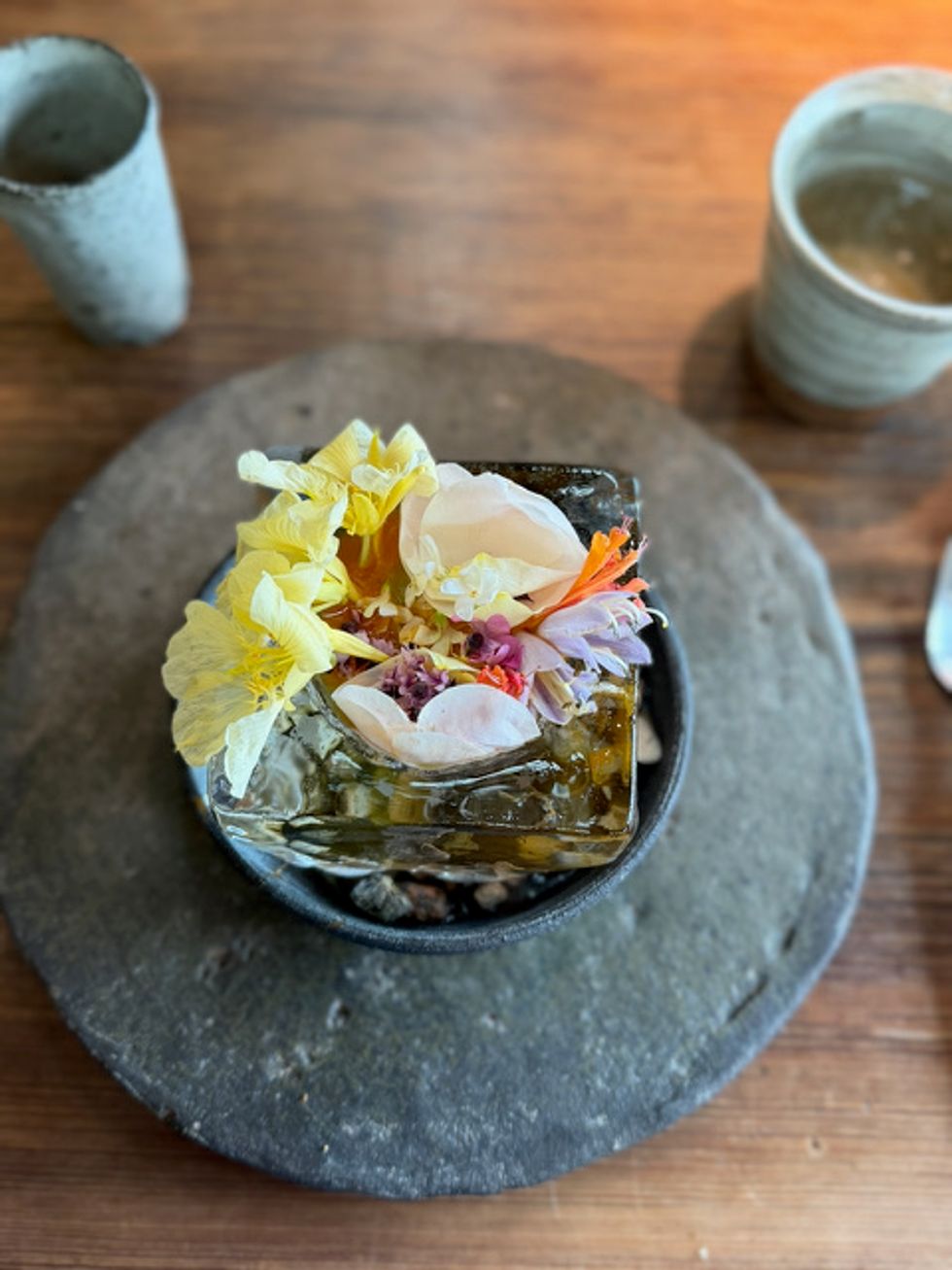
Photo by David Skinner
Flower gazpacho: A cold gooseberry broth under a confetti of fresh garden flowers, served in a block of ice.