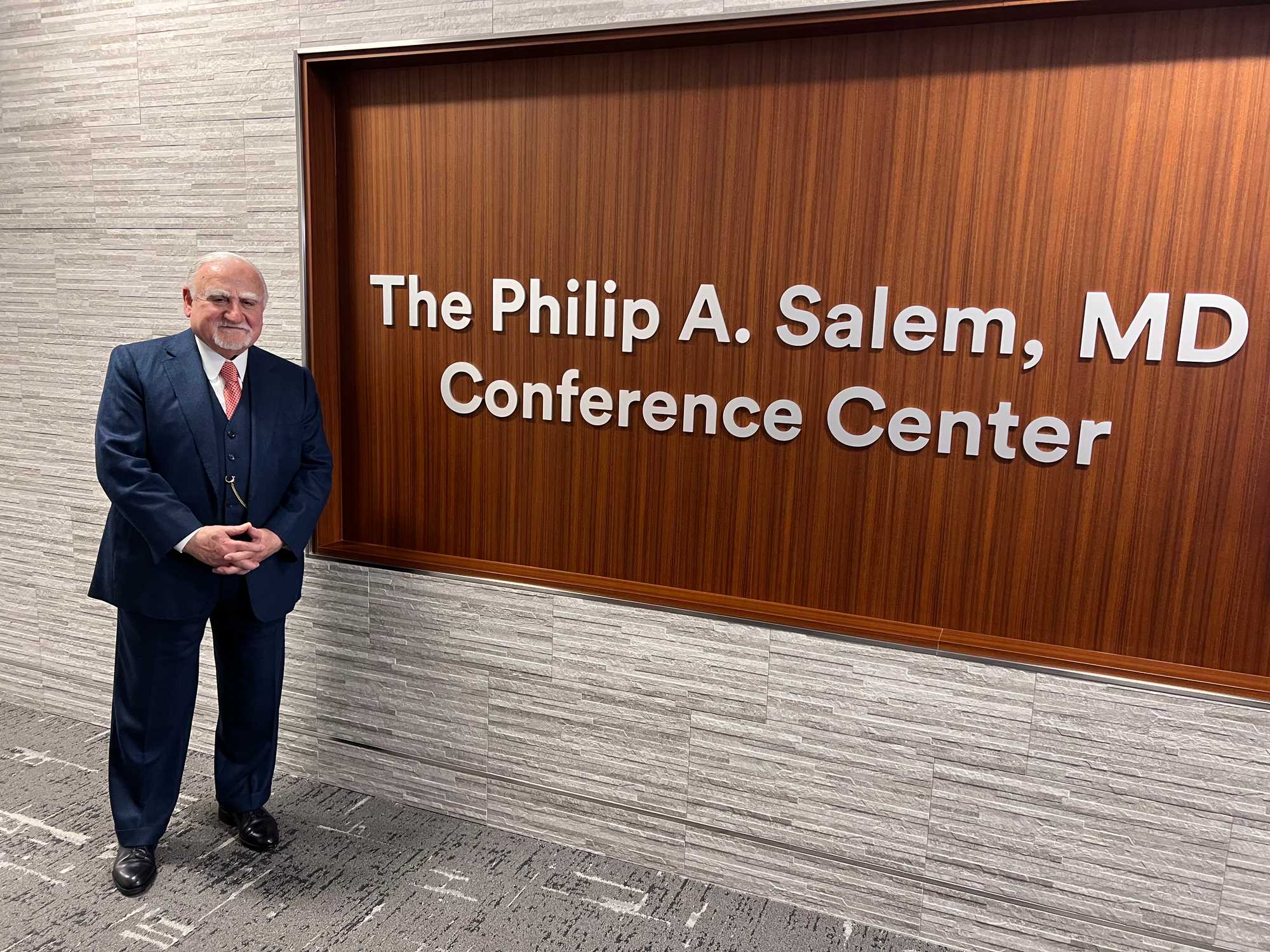
In the heart of Houston’s Texas Medical Center, where some of the world’s most complex medical challenges are confronted daily, a name now marks both history and momentum. The Philip A. Salem Conference Center, newly dedicated inside the Dan Duncan Comprehensive Cancer Center, honors a physician whose work has not only influenced oncology but has challenged its fundamental structure.
For Dr. Philip A. Salem, medicine has never been about accepting limits.
At 84 years old, Salem remains deeply engaged in cancer research and patient care. His career has spanned continents, institutions, and generations of physicians, yet his focus has remained singular: to confront cancer not incrementally, but decisively. Colleagues describe him as relentless in thought and unwavering in purpose — a clinician who refused to accept that advanced malignancy should equate to therapeutic surrender.
The naming dedication ceremony, held in Houston and attended by family, patients, civic leaders, and medical peers, reflected not simply recognition of longevity, but acknowledgment of transformation. Proclamations from the City of Houston and the State of Texas underscored the magnitude of his contributions to cancer research, humanitarian service, and medical education. Yet beyond the formal honors, the moment symbolized something larger: a validation of an idea that has quietly redefined treatment philosophy.
For decades, oncology has relied on a sequential model of therapy. Chemotherapy would be administered first. If progression occurred, immunotherapy might follow. Targeted therapy, when indicated, would often be introduced later. Each modality was deployed independently, cautiously layered over time. This framework, though grounded in clinical rationale, assumed that cancer could be approached in stages.
Salem questioned that assumption.
Advances in genomic science revealed what many researchers suspected but had not fully operationalized: no two cancers are identical at the molecular level. Even within the same diagnostic category, tumors differ profoundly in genetic expression, signaling pathways, and immune behavior. To treat hundreds of patients with a uniform protocol began to seem scientifically discordant.
From this challenge emerged ICTriplex, a strategy that integrates immunotherapy, chemotherapy, and targeted therapy simultaneously rather than sequentially. The approach is not merely additive; it is architecturally different. Each patient undergoes genomic profiling, and treatment is calibrated to the specific molecular characteristics of that individual malignancy. While every patient receives the tripartite combination, no two patients receive the same regimen. The therapy is unified in principle but individualized in execution.
The implications are substantial. By engaging multiple mechanisms of action at once, ICTriplex seeks to prevent cancer cells from adapting between treatment phases, a common pathway to resistance. The immune system is activated while cytotoxic agents reduce tumor burden and targeted agents disrupt precise molecular drivers. Rather than pursuing cancer in steps, the strategy confronts it on several fronts concurrently.
Over the past eight years, the outcomes associated with this approach have drawn increasing attention. In advanced and refractory solid tumors — settings traditionally marked by limited response rates and poor survival — the majority of patients treated have demonstrated measurable response. A significant proportion have achieved complete remission. Perhaps most compelling are cases of individuals once deemed terminal — and ineligible for further therapy at major institutions — who remain alive and without evidence of disease years later.
Such results demand careful interpretation, and Salem himself has long emphasized disciplined scientific evaluation. Yet the clinical signal is difficult to dismiss. In an era when oncology increasingly embraces precision medicine, ICTriplex represents an assertive evolution of that philosophy — one that integrates personalization with simultaneity.
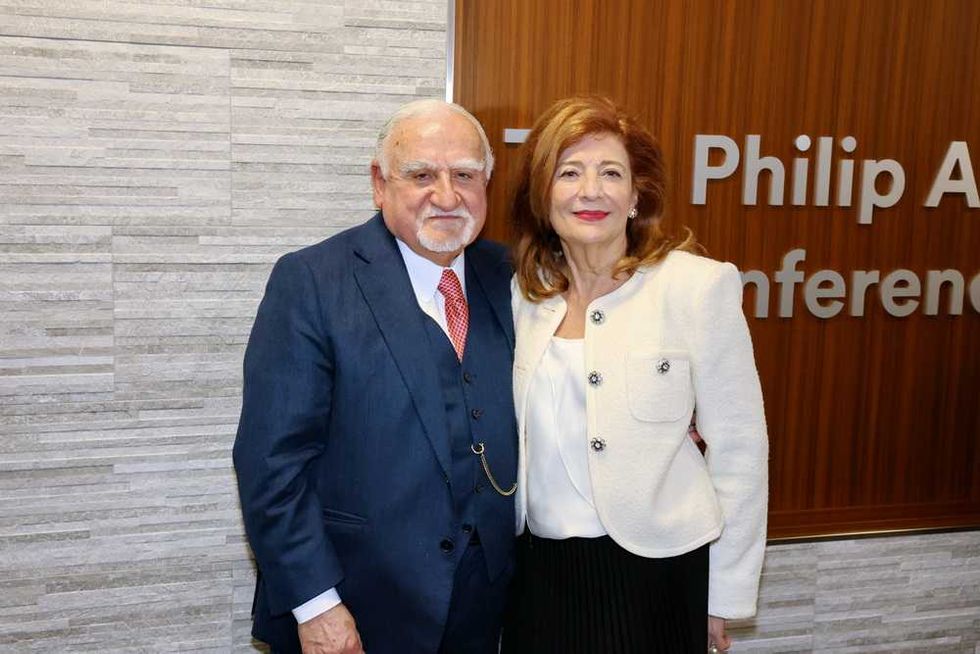 Dr. Philip A. Salem celebrates the naming dedication ceremony. Courtesy photo
Salem’s career has been anchored within institutions central to global cancer care, including Baylor St. Luke’s Medical Center and The University of Texas MD Anderson Cancer Center. As Director Emeritus of Cancer Research at St. Luke’s Episcopal Hospital and President of the Salem Oncology Center, he has shaped not only therapeutic strategy but also generations of physicians. Colleagues frequently recount his insistence that medicine must be both rigorous and humane, that scientific excellence without compassion remains incomplete.
During the dedication ceremony, speakers reflected as much on character as on clinical innovation. Mentorship, intellectual courage, and devotion to patients were recurring themes. Former trainees described an educator who demanded precision but modeled empathy. Patients spoke of a physician who viewed diagnosis not as destiny but as a problem to be solved. Treat the patient, not only the disease.
The conference center that now bears his name will host tumor boards, research symposia, and interdisciplinary collaboration. Future protocols may be conceived within its walls. Young oncologists will gather there, perhaps unaware at first of the full story behind the name etched at its entrance. Over time, they will learn that it represents more than tenure or academic rank. It represents a refusal to accept therapeutic stagnation.
In oncology, progress often arrives incrementally. Occasionally, it arrives through individuals willing to reexamine structure itself. Dr. Philip A. Salem belongs to the latter category — a physician who has spent a lifetime advancing cancer care, and who continues to believe that even the most advanced disease deserves an uncompromising response.
The wall bears his name. The work continues beyond it.