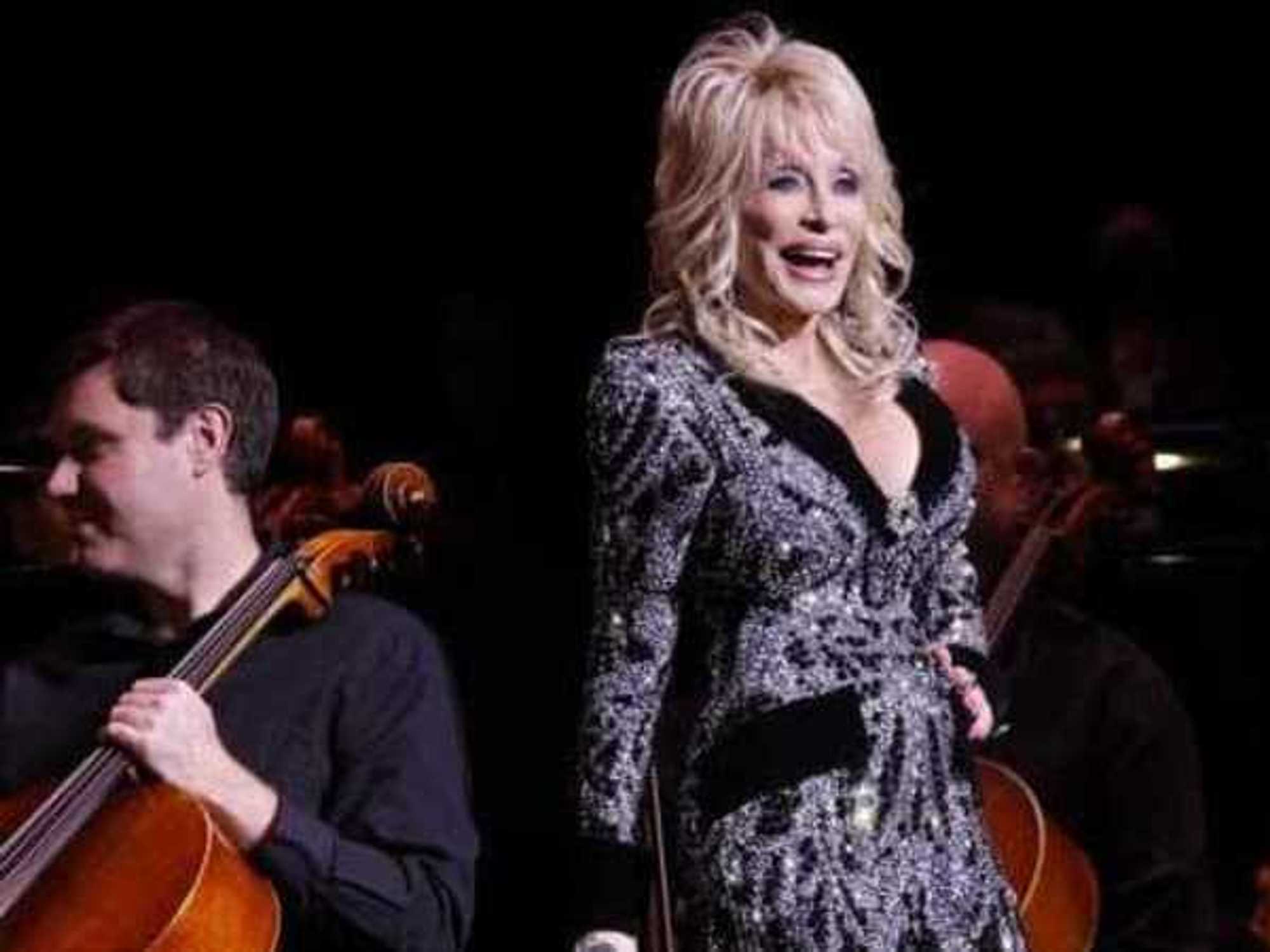
NASHVILLE, Tenn. (AP) — Dolly Parton, the country music icon whose soaring vibrato vocals, poignant songwriting and sparkling costumes defined her rise from a log cabin in the Tennessee mountains to the height of stardom and acclaim, has died. She was 80 years old.
Parton died peacefully Tuesday in Nashville, Tennessee, her publicist said in a statement. A cause of death was not disclosed.
Known for her curvy physique, massive blond wigs and skin-tight outfits that served her self-deprecating wit, she was among the most beloved personalities in music and beyond — the rare celebrity whose appeal transcended generations, geography and politics.
She wrote hundreds of songs, including classics like “Jolene,” “Coat of Many Colors” and “I Will Always Love You,” that totaled more than 100 million worldwide sales and more than 1 billion online streams. Parton, who plucked bejeweled banjos, guitar and dulcimers with her long fingernails during performances, was a generous philanthropist and successful businesswoman whose projects included a theme park in the Smoky Mountain foothills near her birthplace.
Her career was forever influenced by her upbringing as one of 12 children born into what she called a “dirt poor” Tennessee family. She started her education nonprofit, Imagination Library, to send free books to children in Tennessee because her father, who quit school to work on the farm, struggled to learn to read.
Parton's first musical performances were in church, where her grandfather was a preacher. By age 10, she was learning guitar and singing on local television shows. At 13, she appeared on the Grand Ole Opry in Nashville, where Johnny Cash introduced her as “a little girl here from up in East Tennessee.”
With a suitcase of songs, she followed her uncle, Bill Owens, also a songwriter, to Nashville after graduating high school in 1964. Fred Foster, who produced Roy Orbison, Willie Nelson and more, saw her potential and got her songs cut by other artists, as well as recording and releasing Parton singing her own material. By the mid-1970s, Parton was a Nashville queen.
Parton's partnership with Porter Wagoner, a pencil-thin pompadoured star with flashy rhinestone outfits, was key to her career. She honed her acting skills on his syndicated TV show and he advocated for her to get a record deal at RCA. Their first duet, “The Last Thing On My Mind,” was released in 1967, the same year she started her own publishing company.
She got her first No. 1 solo single with “Joshua,” and reached the Top 5 with the ballad “Coat of Many Colors,” about how her mother sewed together scraps of clothes to make a coat Parton wore “so proudly” even as her peers mocked her for being poor. The song, with its Biblical references and ode to maternal love, was later made into a children’s book and a TV movie.
In 1973, she had the hit that made her career — “Jolene,” a country music standard with its steady, churning rhythm and Parton's repeated delivery of the title as she pleads for the woman not to steal her man.
A pop crossover star
She followed “Jolene” with a huge hit in 1974, “I Will Always Love You,” an ode and farewell to Wagoner that helped her win the Country Music Association’s female vocalist of the year back-to-back in 1975 and 1976. She famously turned down Elvis Presley, who wanted to record it, because she would not share publishing rights.
Decades later, Whitney Houston’s version of “I Will Always Love You” became a smash for the soundtrack of her 1992 film “The Bodyguard,” and broke sales records. Houston won a Grammy for her performance in 1994, presented to her by Parton.
“Here You Come Again,” a pop crossover hit and one of the few she didn’t write, further established Parton as a multi-genre entertainer and brought her first Grammy Award in 1979.
“A lot of people thought I had totally lost my mind,” she told The Associated Press in 1979 of changing her singing style. “But I had no fear of change. I expected success, but I was braced for failure. I didn’t care if people thought I was wrong. In my own heart, I knew I was doing the right thing.”
Parton's other crossover hits included the title song from “9 to 5,” the 1980 comedy starring Parton, Jane Fonda and Lily Tomlin; and her duet with longtime friend Kenny Rogers, “Islands in the Stream,” written by brothers Barry, Maurice and Robin Gibb of the Bee Gees. In 1987, she collaborated with Linda Ronstadt and Emmylou Harris on the million-selling “Trio” album.
Down home charm
For millions of fans, she was simply “Dolly,” a mixture of Southern charm, humor and glamour. But she was also considered a feminist role model for holding the reins of her own career, writing her own songs, owning her content and looking after her finances in an entertainment world dominated by men.
Parton was open to making fun of herself; when she hosted “Saturday Night Live” in 1989 she told the writers that her only restrictions were she wouldn’t curse and she wouldn’t make fun of Jesus. She regularly joked about her breasts or her dumb blonde appearance, but with a wink that she was the one controlling the laughs.
Throughout her career, she embraced her glamorous style, often wearing custom curve-hugging rhinestone dresses and bodysuits even if they drew tsk-tsks from others in the industry. Her look was always a part of her larger musical business plan.
“I knew my songs were good even if I had been ugly as sin,” she told the AP in 2014. “So I thought, ‘Well, I would have probably chose to look this way even if I had been a waitress.’ I mean, this is my look. I mean, I like a lot of makeup. I like a lot of hair. I like flashy clothes. I like to show it off. But that’s just who I am.”
She married Carl Dean, an asphalt paving contractor, in the mid-1960s; they were together until his death in 2025 at the age of 82. Though rarely seen in public, he was an influence on her career. She told NPR that she wrote “Jolene” about a flirty bank teller who seemed to take an interest in Dean.
‘9 to 5’ to Hollywood and Broadway
In her first major film role, Parton played alongside Fonda and Tomlin as office workers who rebel against their tyrannical boss in “9 to 5.” Critic Roger Ebert called her a “natural-born movie star” and the title song earned her two Grammy Awards and a ranking of 78 on the American Film Institute's list of top 100 movie songs. Starring roles in “The Best Little Whorehouse In Texas” and “Steel Magnolias” followed.
Her love affair with TV and film continued for decades, with appearances alongside her goddaughter Miley Cyrus on “Hannah Montana” and adaptations of her music for Christmas specials, films and streaming series. She also became an author, her books ranging from the memoir “Dolly” to a bestselling novel co-authored by James Patterson, “Run, Rose, Run."
The stage adaptation “9 to 5: The Musical” debuted in 2009, and “DOLLY: A True Original Musical” is set to open Jan. 19, 2027, on what would have been her 81st birthday.
United States of Dolly
Beyond her music, Parton’s most lasting legacy might be her generosity and broad appeal.
When a deadly wildfire swept through the Smokies in 2016, she held an all-star telethon and set up a foundation that sent monthly checks to residents whose homes were damaged or destroyed.
She opened up her Dollywood theme park in East Tennessee, a major economic driver in Appalachia that draws tourists from around the country, and established the Dollywood Foundation. She wrote books and memoirs, was inducted into the Country Music Hall of Fame and was given a lifetime achievement award by the Recording Academy. She was selected for the Jean Hersholt Humanitarian Award from the Academy of Motion Picture Arts and Sciences in 2025.
With 55 Grammy nominations and 10 wins, Parton is the third-most nominated woman in Grammy history, only behind Beyoncé and Taylor Swift.
Parton spanned social and political divides, through multiple generations of fans, urban and rural and in between. In tumultuous election years, it wasn't uncommon to see “Dolly for President” shirts. But she was strict in not voicing her own political beliefs.
When the Rock & Roll Hall of Fame Foundation sent out a ballot in 2022 with her name on it, though she said she felt she hadn't earned it, the voters answered with a “Hello, Dolly." Parton showed up to the induction ceremony, performed and then put out a rock album.
Ties to Texas
Though Parton didn't live in Texas, it was more than her Southern charm that tied her to the Lone Star State. Her campy persona and many ties to the state endeared her to Texans. The most famous was her lead appearance in the 1982 musical comedy film, The Best Little Whorehouse in Texas, which took place in a fictional town but was filmed on location around Austin.
But with such a long career — in which she was active until her death — there are plenty more Texas connections to look back on.
She co-wrote and filmed the 1991 TV movie Wild Texas Wind at the historic Broken Spoke in Austin. In 2016, she looked back fondly on "[all] the wonderful people in Austin and what a good time we had living there during that period."
"It was just a wonderful time," Parton said. "It was a sad ass story as you know. Gary Busey played an abusive husband. But we really had a lot of fun, and I was proud to be part of that.”
Parton also had a close relationship with Texas country music icon Willie Nelson. The two met in Nashville, and the two country singers later collaborated on some tunes, including their first duet, "From Here to the Moon and Back," in 1982. More than 50 years after their time in Nashville, Parton spoke on the relationship after winning the prestigious Willie Nelson Lifetime Achievement Award at the 2016 CMA Awards Show.
"Well, I love Willie as much as I love anybody outside of my own family, and he feels like family to me," said Parton. "... We used to sit out in the same building and write songs for the same publishing company and record for the same record label, and we've known each other for a long time."
The pair collaborated on a 1977 tour.
Parton famously only played the Houston Livestock Show and Rodeo once, all the way back in 1978, but she led lists of performers that Houstonians most wanted to see return to the star-shaped stage. “While Parton still continues to make new music with the likes of Sabrina Carpenter, she’s said she’s done touring aside from special shows. Well, RodeoHouston is pretty dang special, we think,” CultureMap music expert Craig Hlavaty wrote last year.
HLSR paid tribute to Parton on social media.
Indeed, it’s been almost 10 years since Parton brought her Pure & Simple Tour to NRG Arena in December 2016. She demonstrated her versatility by playing the banjo, fiddle, saxophone, dulcimer, piano, autoharp, harmonica and other instruments at various times throughout the concert.
“Even though she chatted incessantly between songs, telling long stories about her parents and growing up poor in the mountains of Tennessee in what seemed to be a ploy to give her body time to recover in order to belt out yet another big song — at one point she even admitted she was stalling, "trying to catch my breath," Parton more than proved that she can still captivate a crowd,” Clifford Pugh wrote in his review.
Parton also had many appearances in Dallas-Fort Worth, including as co-host (with Garth Brooks) of the ACM Awards in Frisco in 2023. During the broadcast, Parton sang rock 'n' roll, wheeled a goat on stage, and Facetime'd with Willie Nelson.
In one of her last and most memorable Texas appearances, Parton headlined the 2023 halftime show between the Dallas Cowboys and the Washington Commanders at AT&T Stadium in Arlington.
Her performance became as buzzed-about for her wardrobe choice — the iconic, skimpy Dallas Cowboys Cheerleaders uniform — as it did for her musical delivery. "Well, hello, Dallas! Dolly does Dallas. You like my outfit?" she asked the adoring crowd from the stage.
Her appearance even got its own segment, appropriately titled "9 to 5," in the hit Netflix docu-series America's Sweethearts: Dallas Cowboys Cheerleaders.
---
Stephanie Allmon Merry and Eric Sandler contributed to this report.