Danish filmmaker Nicolas Winding Refn is not someone who plays nice with the general film world. His 2011 film Drive introduced him to American audiences in a big way, but that pulsating thriller was followed up with artier films like Only God Forgives and The Neon Demon that eschewed coherent plots in favor of moody, atmospheric pieces.
Winding Refn, who hasn’t made a feature film in 10 years, has gone fully down the rabbit hole with Her Private Hell. Taking place in a liminal space that kind of resembles Earth but also feels like someone’s dreams/nightmares, the film focuses on Elle (Sophie Thatcher), an actor currently starring in a sci-fi film. Staying at a hotel with newcomer Hunter (Kristine Froseth), the two bond over their shared passion and the legend of Elle’s father, Johnny Thunders (Dougray Scott), who’s now married to Elle’s friend Dominique (Havana Rose Liu).
After spending a good amount of (mostly incomprehensible) time with that group, Refn introduces Private K (Charles Melton), who seems to be living in post-World War II Japan. He is looking for his daughter, who might have been taken by a mysterious figure known as “Leatherman,” and he will stop at nothing to find her, fighting whoever stands in his way.
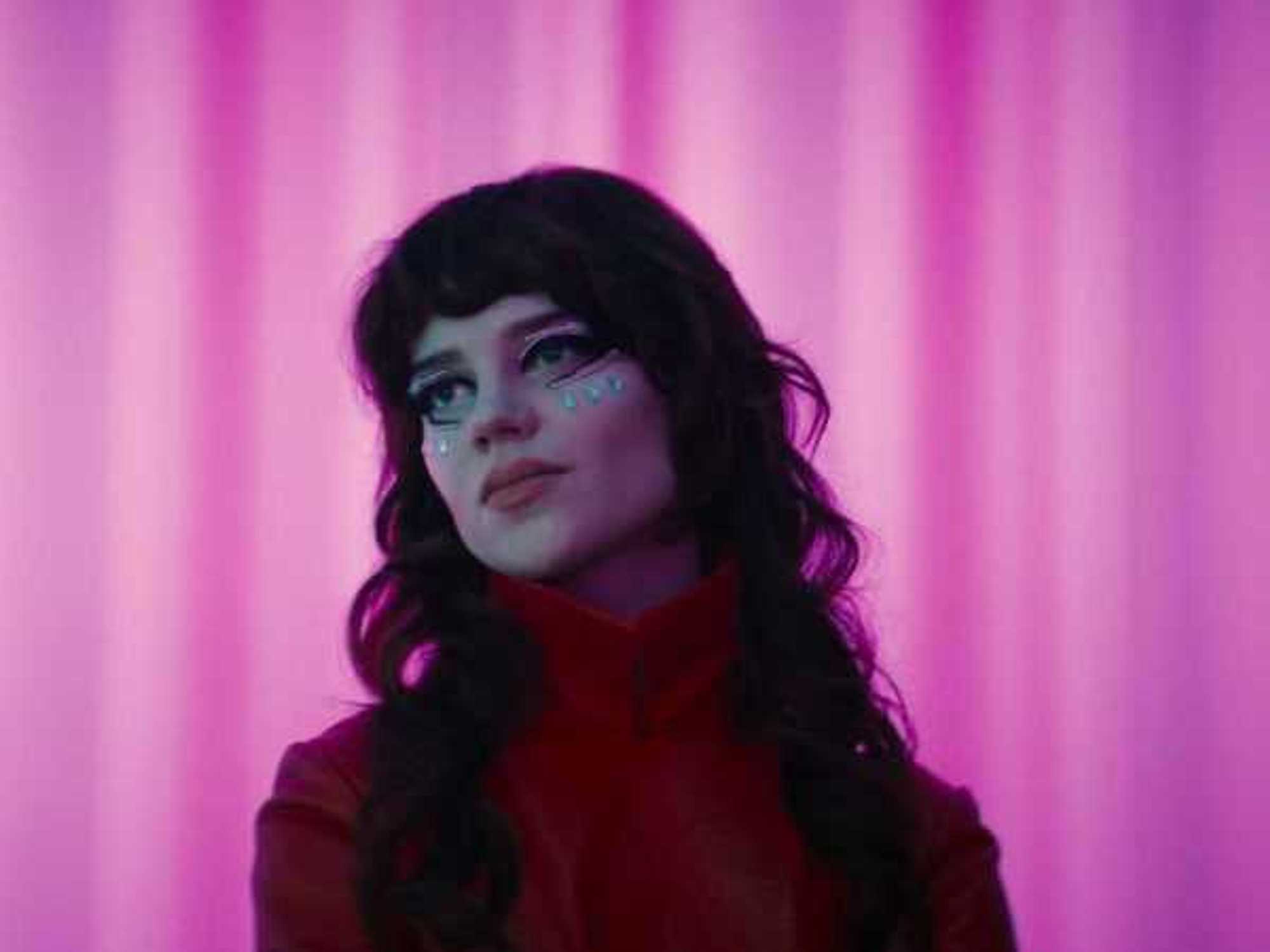
It becomes clear almost right away that Winding Refn has no desire to engage in traditional storytelling in this film. The main characters wander through neon-drenched streets and buildings, which are often surrounded by a mist that is referred to on multiple occasions but never explained. Everyone speaks as if in a constant state of wonderment, and there are many moments where it’s unclear if events are actually happening, part of a movie-within-a-movie, or something else entirely.
Unlike his previous films, Winding Refn has taken the characters in this film completely out of the real world, with every scene taking place in a sparsely decorated room or street that is obviously a movie set. While there are moments where this decision really works, especially the striking first shot of a human-like figure mixed in with a cityscape and clouds, most of the time it only adds to the stilted nature of the film as a whole.
In fact, the entire movie has the feel of an avant-garde theater exercise. Every actor seems to be trying to outdo the others with awkward performances and out-sized reactions. Two very specific characters make appearances in both sides of the story for seemingly no reason other than to inject their weirdness into both spaces. The shocking violence that crops up on occasion would have more of an impact if it was related to anything intelligible.
Thatcher (Companion) and Liu (Tuner) are among the young stars who have had breakout moments in recent years, but neither of them is served well by this hot mess of a movie. They, along with Melton, still demonstrate the talent they possess, but the oddity of the film weighs them down. Scott makes an impression for all the wrong reasons, while Froseth is called upon to play a character who might as well not be there at all.
If there’s any kind of message that Winding Refn was trying to convey with Her Private Hell, it’s lost among the flashing lights, overload of pink, and jewel-like structures. Filmmakers who try to make art for art’s sake have a place in the world, but this film too often feels like people are making things up as they go, with no real goal in mind.
---
Her Private Hell opens in theaters on July 24.