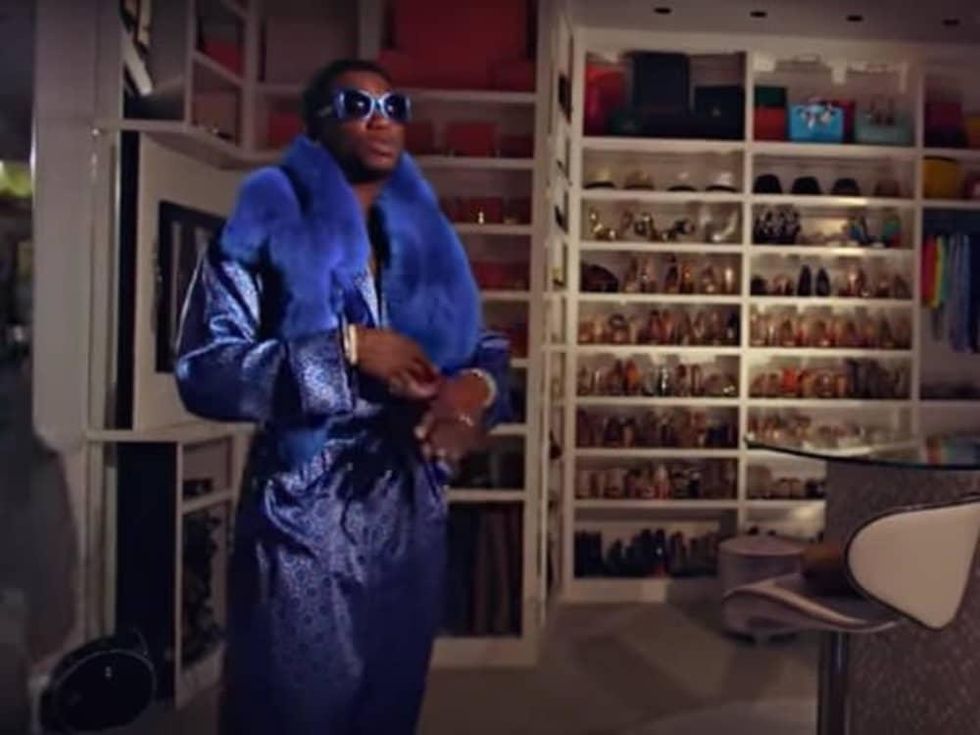
Just in time for Christmas, hip-hop artist Gucci Mane gave his fans a naughty but nice present. The video for his new single, "Nonchalant," which was shot at Lamar and Theresa Roemer's Woodlands home earlier this month, was released over the weekend.
As CultureMap previously reported, representatives from Atlantic Records secured permission from the couple to shoot the glitzy R-rated video at their palatial 17,300-square-foot Carlton Woods mansion. The song is taken from Mane's mixtape, The Return of the East Atlanta Santa, which was released in mid-December. It opens with the singer in Theresa's infamous 3,000-square closet, where he is surrounded by designer handbags and scantily-clad models offering him up an array of name brand sunglasses on a silver tray.
In the chorus of the song, Mane reflects on being "in the strip club chilling so nonchalant," so director Be EL Be transformed part of the mansion into the singer's private strip club, with brass poles suspended in the bedroom and wine room, a model laid out on the kitchen counter wearing nothing but sushi, and other curvaceous models cavorting in the master bath. While the female models wear barely nothing throughout the video, Mane is outfitted in a variety of furs, colorful jackets, platinum chains and glittery rings.
It follows a similar theme as his previous music video for ”Stutter” and the release of ”Both,” which features Drake. Both songs are on The Return of the East Atlanta Santa album.
Since being released from prison earlier this spring, where he was serving a three-year sentence for federal drug and gun charges, Mane has been on a tear, releasing three albums — Everybody Looking in July, Woptober in October, and The Return Of East Atlanta Santa.
Much of the beginning of the video was shot in Theresa Roemer's closet.

Courtesy photo
Much of the beginning of the video was shot in Theresa Roemer's closet.

For a series whose first two films made over $5 billion combined worldwide, Avatar has a curious lack of widespread cultural impact. The films seem to exist in a sort of vacuum, popping up for their run in theaters and then almost as quickly disappearing from the larger movie landscape. The third of five planned movies, Avatar: Fire and Ash, is finally being released three years after its predecessor, Avatar: The Way of Water.
The new film finds the main duo, human-turned-Na’vi Jake Sully (Sam Worthington) and his native Na’vi wife, Neytiri (Zoë Saldaña), still living with the water-loving Metkayina clan led by Ronal (Kate Winslet) and Tonowari (Cliff Curtis). While Jake and Neytiri still play a big part, the focus shifts significantly to their two surviving children, Lo’ak (Britain Dalton) and Tuk (Trinity Jo-Li Bliss), as well as two they’ve essentially adopted, Kiri (Sigourney Weaver) and Spider (Jack Champion).
Miles Quaritch (Stephen Lang), who lives on in a fabricated Na’vi body, is still looking for revenge on Jake, and he finds help in the form of the Mangkwan Clan (aka the Ash People), led by Varang (Oona Chaplin). Quaritch’s access to human weapons and the Mangkwan’s desire for more power on the moon known as Pandora make them a nice match, and they team up to try to dominate the other tribes.
Aside from the story, the main point of making the films for writer/director James Cameron is showing off his considerable technical filmmaking prowess, and that is on full display right from the start. The characters zoom around both the air and sea on various creatures with which they’ve bonded, providing Cameron and his team with plenty of opportunities to put the audience right there with them. Cameron’s preferred viewing method of 3D makes the experience even more immersive, even if the high frame rate he uses makes some scenes look too realistic for their own good.
The story, as it has been in the first two films, is a mixed bag. Cameron and co-writers Rick Jaffa and Amanda Silver start off well, having Jake, Neytiri, and their kids continue mourning the death of Neteyam (Jamie Flatters) in the previous film. The struggle for power provides an interesting setup, but Cameron and his team seem to drag out the conflict for much too long. This is the longest Avatar film yet, and you really start to feel it in the back half as the filmmakers add on a bunch of unnecessary elements.
Worse than the elongated story, though, is the hackneyed dialogue that Cameron, Jaffa, and Silver have come up with. Almost every main character is forced to spout lines that diminish the importance of the events around them. The writers seemingly couldn’t resist trying to throw in jokes despite them clashing with the tone of the scenes in which they’re said. Combined with the somewhat goofy nature of the Na’vi themselves (not to mention talking whales), the eye-rolling words detract from any excitement or emotion the story builds up.
A pre-movie behind-the-scenes short film shows how the actors act out every scene in performance capture suits, lending an authenticity to their performances. Still, some performers are better than others, with Saldaña, Worthington, and Lang standing out. It’s more than a little weird having Weaver play a 14-year-old girl, but it works relatively well. Those who actually get to show their real faces are collectively fine, but none of them elevate the film overall.
There are undoubtedly some Avatar superfans for which Fire and Ash will move the larger story forward in significant ways. For anyone else, though, the film is a demonstration of both the good and bad sides of Cameron. As he’s proven for 40 years, his visuals are (almost) beyond reproach, but the lack of a story that sticks with you long after you’ve left the theater keeps the film from being truly memorable.
---
Avatar: Fire and Ash opens in theaters on December 19.