As far as art exhibitions go, the most profound are rooted in a simple idea. Picasso Black and Whiteat the Museum of Fine Arts, Houston fits that bill.
___ A new modernism suffused Picasso's style in the 1960s, a happier time for the artist now married to his second wife, Jacqueline Roque [http: /en.wikipedia.org/wiki/Jacqueline_Roque], and living near Cannes. Reclining Woman Reading isn't a portrait of Roque, but a tribute to the great sleeping nudes of his predecessors like Titian's Venus of Urbino [https://en.wikipedia.org/wiki/Venus_of_Urbino] or Édouard Manet's Olympia [https://en.wikipedia.org/wiki/Olympia_(painting)]. Except this contemporary goddess is reading a paperback book in all her glory, supported by an avant garde lounger.
___ A new modernism suffused Picasso's style in the 1960s, a happier time for the artist now married to his second wife, Jacqueline Roque [https: /en.wikipedia.org/wiki/Jacqueline_Roque], and living near Cannes. Reclining Woman Reading isn't a portrait of Roque, but a tribute to the great sleeping nudes of his predecessors like Titian's Venus of Urbino [https://en.wikipedia.org/wiki/Venus_of_Urbino] or Édouard Manet's Olympia [https://en.wikipedia.org/wiki/Olympia_(painting)]. Except this contemporary goddess is reading a paperback book in all her glory, supported by an avant garde lounger.
Pablo Picasso, Reclining Woman Reading, 1960, oil on canvas, Collection of the Modern Art Museum of Fort Worth, museum purchase, The Benjamin J. Tillar Memorial Trust
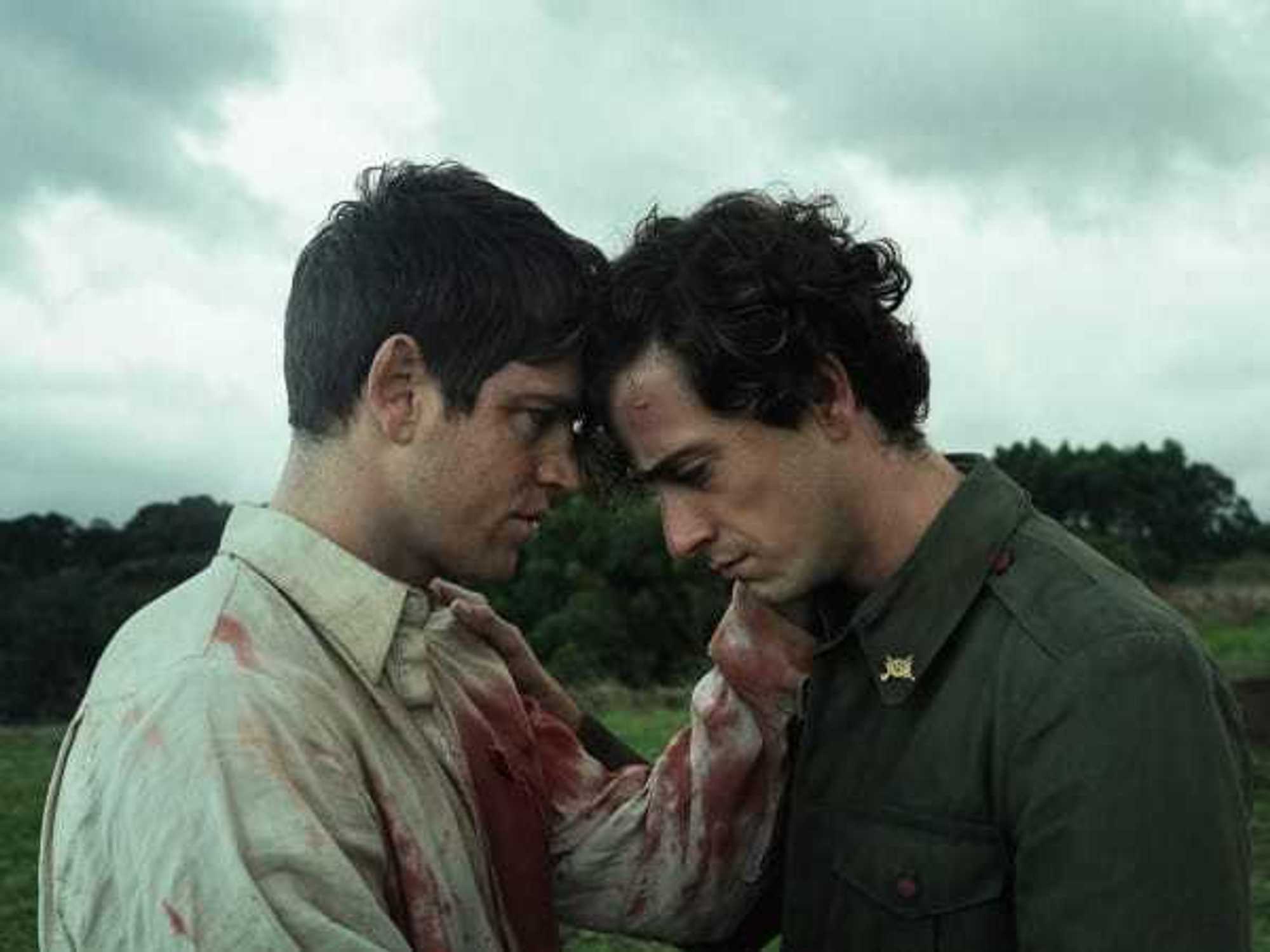
Miguel Bernardeau and Guitarricadelafuente in La Bola Negra.
For a long time — too long — gay characters in movies tended to appear as either side characters with no real stories or as tragic figures who were usually unable to express their true selves for fear of what the world at large would think. That has changed in recent years, but the remnants of the past can still haunt, as the new film La Bola Negrademonstrates.
The film takes shape in storylines involving three different men: Carlos (Milo Quifes), a young man in Granada, Spain in 1932 who wants to join an exclusive casino (aka social club); Sebastián (Guitarricadelafuente), who unwillingly joins the military during the Spanish Civil War in 1937, only to have desires aroused in him when he’s asked to guard an enemy detainee; and Alberto (Carlos González), an out gay man in 2017 whose inheritance from his recently-deceased grandfather opens up a world he knew nothing about.
The film goes back and forth between each man, detailing how they handle their individual situations and the complications that arise in their individual lives. Along the way their stories are deepened through people they meet who either welcome them with open arms or shun them for various reasons. While tragedy bonds their stories, so too does hope, resistance, and love.
Co-director/co-writers Javier Calvo and Javier Ambrossi, along with co-writer Alberto Conejero, have expanded Conejero’s play, La Piedra Oscura, which was inspired by Federico García Lorca’s unfinished play, La Bola Negra. Lorca, who was killed during the Spanish Civil War, had only finished four pages of the work, his first to feature an openly gay protagonist. It’s clear there’s a desire by the filmmakers to honor the legacy of Lorca as both a playwright and a gay man, and the seriousness of their pursuit is evident throughout the film’s 160 minutes.
Calvo and Ambrossi do little handholding to guide viewers through the three distinct stories, an approach that mostly works but occasionally leads to confusion, especially as more characters are added to the equation. None of the stories are overly complicated, but they take their time with each, making the long film feel even longer. Only Alberto’s story contains any kind of development that might be considered surprising, making it tough to fully engage with the other two.
Where the film does come alive is when it brings in two well-known actors for brief-but-fascinating stints. Penélope Cruz plays Nené Romero, a singer who entertains the troops and further expands Sebastián’s mind. Glenn Close pops up as Isabelle Durand, a scholar of Lorca who helps Alberto with a unique discovery he makes in his inheritance. Both actors bring up the level of the film significantly through their performances.
Quifes, Guitarricadelafuente (the stage name of Spanish singer Álvaro Lafuente Calvo, no relation to Javier), and González all put in good work in their roles, even if none are overly engaging. They are often overshadowed by supporting actors like Cruz and Close, as well as Miguel Bernardeau as Rafael Rodríguez Rapún, the captured soldier; Julio Torres as Alberto’s partner, and Alberto Cortés as Lorca, who brings a symmetry to the film as a whole.
La Bola Negra — which means “the black ball,” represented both literally and figuratively in the film — is an ambitious film that becomes a slight victim of its filmmakers’ aspirations. Although each of the three stories contain interesting elements, a strong emotional connection is lacking overall despite good-to-great performances.
---
La Bola Negra is now playing in select theaters; it debuts on Netflix on December 2.