It may be time to turn in the Spidey-Man costume, Tobey Maguire.
The British are coming! Tobey Maguire's title role as Spider-Man is being usurped in the new Spider-Man Reboot by the United Kingdom's Jamie Bell, who won fame in 2000 for his leading part in Billy Elliot. In America, he is also known as the former boyfriend of American actress Evan Rachel Wood, who is now linked to Marilyn Manson.
The 24-year-old Billingham, England native is in the upper age range for the part, as director Marc Webb is trying to give the franchise a fresh look by bringing the character of Peter Parker back to high school. Other candidates included Alden Ehrenreich, Frank Dillane, Andrew Garfield and Josh Hutcherson. Bell brings some serious acting accolades. He won the award for Best Actor in a Leading Role at the British Film Awards in 2000 for Billy Elliot, and has also starred in movies including King Kong, Jumper and Defiance.
A little British invasion is never minded, but realize that this is the fourth installment of the Spider-Man movie series. Sony is going to need a lot more than a charming accent to infuse the franchise with superior Spidey-senses. Is it possible that Webb is in a standoff competition with the makers of Shrek for who can create the most undesired summer sequels?
Columbia Pictures is officially "not commenting" on Bell's involvement with the production, which will be released on July 3, 2012.
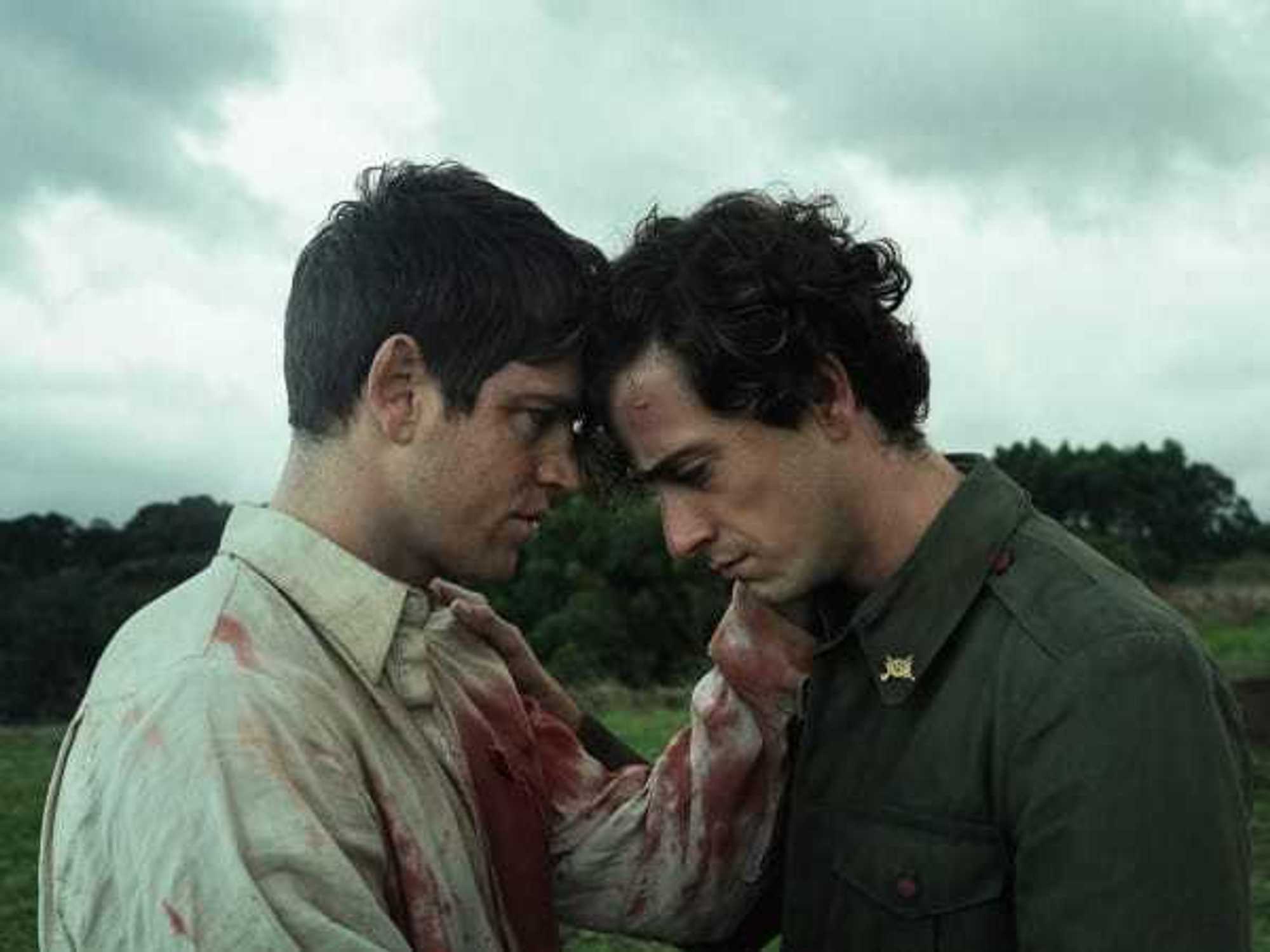
Miguel Bernardeau and Guitarricadelafuente in La Bola Negra.
For a long time — too long — gay characters in movies tended to appear as either side characters with no real stories or as tragic figures who were usually unable to express their true selves for fear of what the world at large would think. That has changed in recent years, but the remnants of the past can still haunt, as the new film La Bola Negrademonstrates.
The film takes shape in storylines involving three different men: Carlos (Milo Quifes), a young man in Granada, Spain in 1932 who wants to join an exclusive casino (aka social club); Sebastián (Guitarricadelafuente), who unwillingly joins the military during the Spanish Civil War in 1937, only to have desires aroused in him when he’s asked to guard an enemy detainee; and Alberto (Carlos González), an out gay man in 2017 whose inheritance from his recently-deceased grandfather opens up a world he knew nothing about.
The film goes back and forth between each man, detailing how they handle their individual situations and the complications that arise in their individual lives. Along the way their stories are deepened through people they meet who either welcome them with open arms or shun them for various reasons. While tragedy bonds their stories, so too does hope, resistance, and love.
Co-director/co-writers Javier Calvo and Javier Ambrossi, along with co-writer Alberto Conejero, have expanded Conejero’s play, La Piedra Oscura, which was inspired by Federico García Lorca’s unfinished play, La Bola Negra. Lorca, who was killed during the Spanish Civil War, had only finished four pages of the work, his first to feature an openly gay protagonist. It’s clear there’s a desire by the filmmakers to honor the legacy of Lorca as both a playwright and a gay man, and the seriousness of their pursuit is evident throughout the film’s 160 minutes.
Calvo and Ambrossi do little handholding to guide viewers through the three distinct stories, an approach that mostly works but occasionally leads to confusion, especially as more characters are added to the equation. None of the stories are overly complicated, but they take their time with each, making the long film feel even longer. Only Alberto’s story contains any kind of development that might be considered surprising, making it tough to fully engage with the other two.
Where the film does come alive is when it brings in two well-known actors for brief-but-fascinating stints. Penélope Cruz plays Nené Romero, a singer who entertains the troops and further expands Sebastián’s mind. Glenn Close pops up as Isabelle Durand, a scholar of Lorca who helps Alberto with a unique discovery he makes in his inheritance. Both actors bring up the level of the film significantly through their performances.
Quifes, Guitarricadelafuente (the stage name of Spanish singer Álvaro Lafuente Calvo, no relation to Javier), and González all put in good work in their roles, even if none are overly engaging. They are often overshadowed by supporting actors like Cruz and Close, as well as Miguel Bernardeau as Rafael Rodríguez Rapún, the captured soldier; Julio Torres as Alberto’s partner, and Alberto Cortés as Lorca, who brings a symmetry to the film as a whole.
La Bola Negra — which means “the black ball,” represented both literally and figuratively in the film — is an ambitious film that becomes a slight victim of its filmmakers’ aspirations. Although each of the three stories contain interesting elements, a strong emotional connection is lacking overall despite good-to-great performances.
---
La Bola Negra is now playing in select theaters; it debuts on Netflix on December 2.

 Actor Jamie Bell
 It may be time to turn in the Spidey-Man costume, Tobey Maguire.