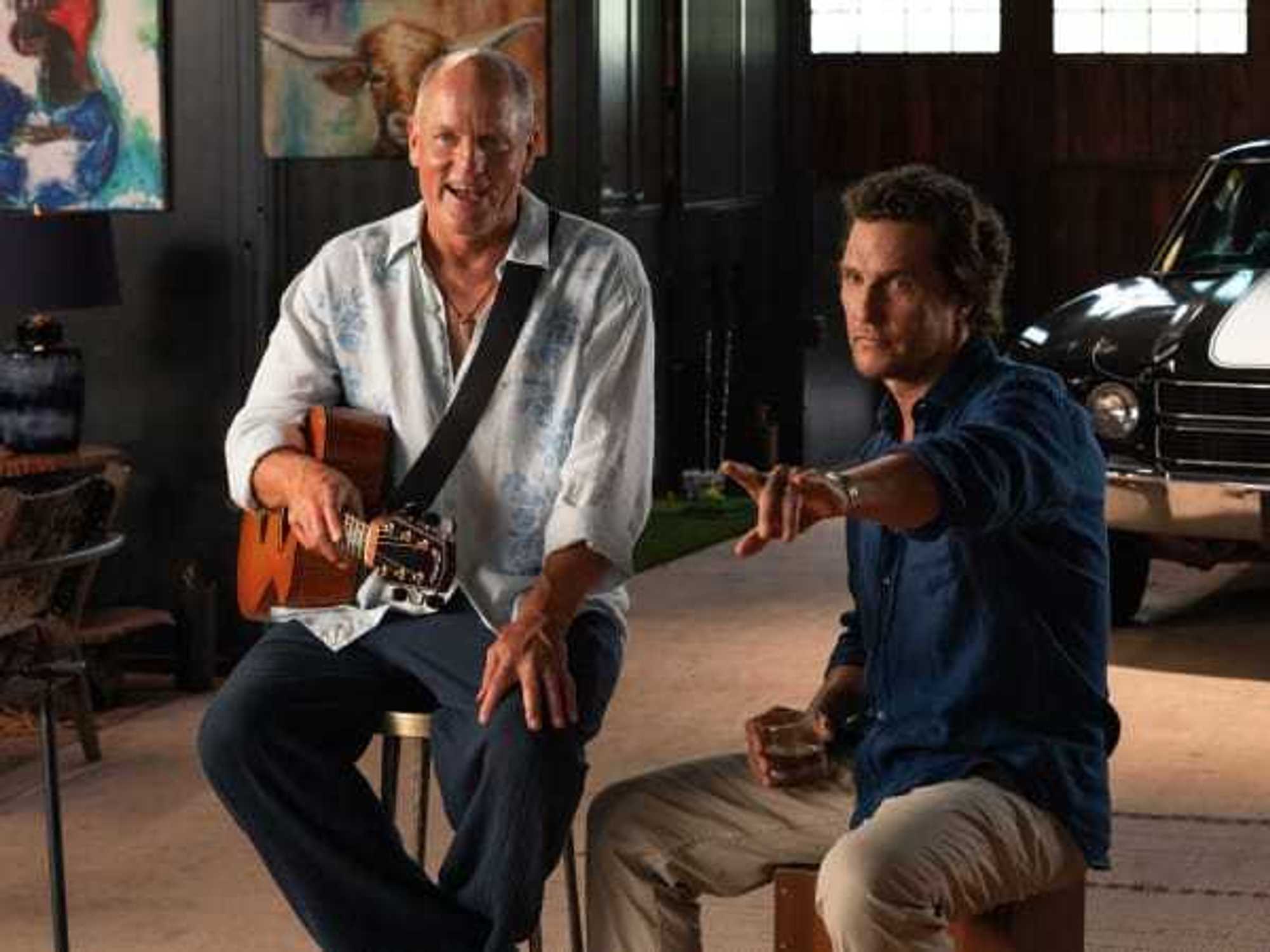
Imaginary siblings and real life best friends Matthew McConaughey and Woody Harrelson are finally about to bring the joke home with a new Apple TV series, Brothers, out globally September 23.
The first two episodes will come out together, and one new episode will be added every Wednesday through November 4, a press release says. There will be eight episodes in total.
In a rumor that gets harder to search for the closer Brothers comes to fruition, McConaughey and Harrelson have leaned into ideas that they might be half-brothers, partially because of their longtime friendship and partially because they have a similar look that gets even stronger in old photos. The topic sprung up when Brothers was in its infancy as a project called Brother from Another Mother, and McConaughey's mom validated it by insinuating that she and Harrelson's father once had a fling.
In Brothers, a heartfelt comedy, McConaughey and Harrelson play fictionalized versions of themselves living out almost the same drama, with much more serious repercussions.
When Harrelson's family needs a place to get away after his daughter's wedding falls through, they travel to Austin to accept the hospitality of a friend, McConaughey. But when McConaughey's mother, Ma Mac (Holland Taylor) accidentally reveals that they might be half-brothers, Harrelson becomes obsessed with learning the truth. Simultaneously, McConaughey considers running for Governor of Texas. (Is this getting too real?)
Other members of the ensemble cast include Natalie Martinez, Brittany Ishibashi, Nolan Almeida, Ella Grace Helton, Noah Carganilla, Highdee Kuan, and Oona Yaffe.
Brothers is produced by Paramount Television Studios, and showrun and executive produced by Lee Eisenberg, best known for producing The Office. McConaughey and Harrelson are also both executive producers alongside Natalie Sandy, David West Read, Trish Hofmann, Bill Bost, Jason Winer, David Finkel and Brett Baer, and Jeremy Plager, the release says. Multiple episodes are directed by Trent O’Donnell, including the pilot.
Austinites were keyed into the production early when locals spotted McConaughey and Harrelson with a film crew on South Congress Avenue. Photographers also caught them in different costumes, this time on South Congress and West Riverside Drive, so it seems like recognizable places around town will be on display multiple times throughout the series.