
remembering injustice
New downtown park will shine a light on a dark part of Houston's past
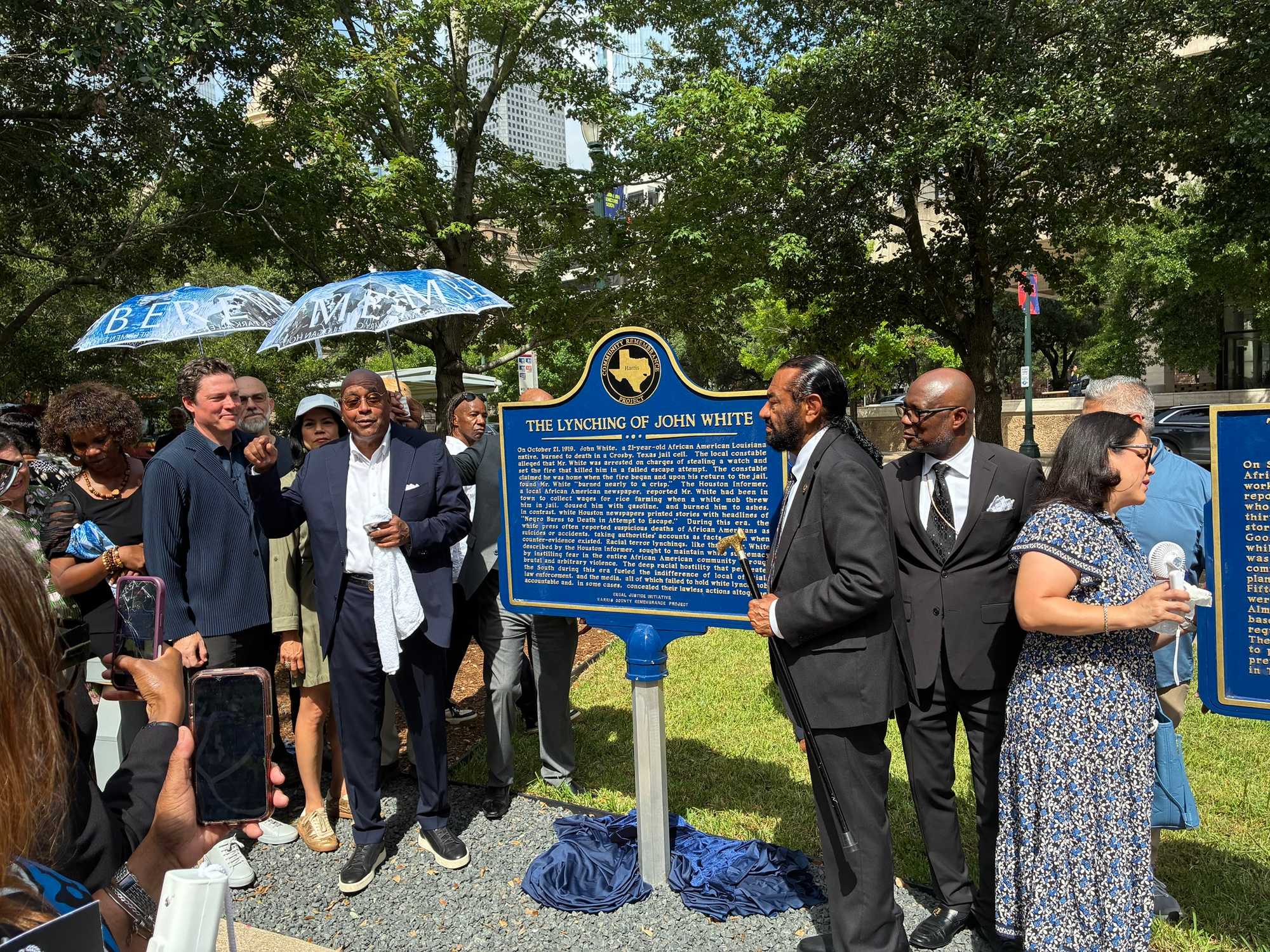
Harris County Commisioner Rodney Ellis and Rep. Al Green posing in front of new historical markers for Remembrance Park.
On Saturday, June 20, Harris County Commissioner Rodney Ellis revealed the full plans for Remembrance Park, a three-block greenspace that will connect Buffalo Bayou to the Herbert W. Gee Municipal Courthouse at 1400 Lubbock St. The park will also include historical markers dedicated to four Black Houstonians who were lynched between 1890 and 1928 — Robert Powell, John White, Burl Smith, and John Walton.
The markers will be installed temporarily at Commissioner El Franco Lee Public Service Plaza until the completion of Remembrance Park, estimated for 2029. The projected is estimated to cost $42 million, though final funding numbers have not been released. Remembrance Park is funded through a combination of Harris County tax revenue and a grant from the Ford Foundation.
Walter Hood of HOOD Design Studios and Michael Murphy of AMMA presented renderings of the future park. It will be a combination of gardens, pavilions, and overlooks that can be used for multiple purposes. In the center of the park will be an innovative fountain. When filled with an inch of water, it will reflect the sky. When emptied, it will show a massive photograph of a baptism in Buffalo Bayou by a Black congregation from the early 20th Century.
The connection to the bayou is woven throughout the park. There are gardens based on Hush Harbors, which were used by Black residents as congregation spaces, as well as canopies made with reclaimed wood and moss from the bayou. The landscape itself will change depending on the rainfall, with features built with retaining ponds to create water installations.
Construction of the park will begin in 2027.
Dr. Ruth Simmons, a President's Distinguished Fellow at Rice University, former president of Prairie View A&M University, and the first African-American president of an Ivy League institution (Brown University) spoke about the importance of remembering history accurately despite attempts to sanitize the past.
"A community that endorses ignoring the history of fabricating that history invites corruption in other areas," she said. "In order to have a common project which we desperately need in this nation, a common project across difference, we must commit to walking in truth. Truth brings light to what darkness would destroy."
The mission statement of Remembrance Park is to "tell the story of the legacy of enslavement and systemic oppression faced by Black Americans in the United States." To accomplish that, the park will have art and education installations, a witness grove, and the lynching markers.
Following the presentation, Ellis and others led the crowd to Lee Plaza for the unveiling of the markers. The unveiling included Representative Al Green and was opened with a prayer from Bishop James Dixon of of Community Faith Church. The bishop thanked Ellis for advocating for the park.
"Today, Rodney Ellis, I see your face in the faces of the great liberators who stood up to injustice, stood up to evil, using creativity and brilliance, bringing people together," Bishop Dixon said.

 Barbacana is closing after two years. Courtesy of Barbacana