• Home
  • popular
  • EVENTS
  • submit-new-event
  • CHARITY GUIDE
  • Children
  • Education
  • Health
  • Veterans
  • Social Services
  • Arts + Culture
  • Animals
  • LGBTQ
  • New Charity
  • TRENDING NEWS
  • News
  • City Life
  • Entertainment
  • Sports
  • Home + Design
  • Travel
  • Real Estate
  • Restaurants + Bars
  • Arts
  • Society
  • Innovation
  • Fashion + Beauty
  • subscribe
  • about
  • series
  • Embracing Your Inner Cowboy
  • Green Living
  • Summer Fun
  • Real Estate Confidential
  • RX In the City
  • State of the Arts
  • Fall For Fashion
  • Cai's Odyssey
  • Comforts of Home
  • Good Eats
  • Holiday Gift Guide 2010
  • Holiday Gift Guide 2
  • Good Eats 2
  • HMNS Pirates
  • The Future of Houston
  • We Heart Hou 2
  • Music Inspires
  • True Grit
  • Hoops City
  • Green Living 2011
  • Cruizin for a Cure
  • Summer Fun 2011
  • Just Beat It
  • Real Estate 2011
  • Shelby on the Seine
  • Rx in the City 2011
  • Entrepreneur Video Series
  • Going Wild Zoo
  • State of the Arts 2011
  • Fall for Fashion 2011
  • Elaine Turner 2011
  • Comforts of Home 2011
  • King Tut
  • Chevy Girls
  • Good Eats 2011
  • Ready to Jingle
  • Houston at 175
  • The Love Month
  • Clifford on The Catwalk Htx
  • Let's Go Rodeo 2012
  • King's Harbor
  • FotoFest 2012
  • City Centre
  • Hidden Houston
  • Green Living 2012
  • Summer Fun 2012
  • Bookmark
  • 1987: The year that changed Houston
  • Best of Everything 2012
  • Real Estate 2012
  • Rx in the City 2012
  • Lost Pines Road Trip Houston
  • London Dreams
  • State of the Arts 2012
  • HTX Fall For Fashion 2012
  • HTX Good Eats 2012
  • HTX Contemporary Arts 2012
  • HCC 2012
  • Dine to Donate
  • Tasting Room
  • HTX Comforts of Home 2012
  • Charming Charlie
  • Asia Society
  • HTX Ready to Jingle 2012
  • HTX Mistletoe on the go
  • HTX Sun and Ski
  • HTX Cars in Lifestyle
  • HTX New Beginnings
  • HTX Wonderful Weddings
  • HTX Clifford on the Catwalk 2013
  • Zadok Sparkle into Spring
  • HTX Let's Go Rodeo 2013
  • HCC Passion for Fashion
  • BCAF 2013
  • HTX Best of 2013
  • HTX City Centre 2013
  • HTX Real Estate 2013
  • HTX France 2013
  • Driving in Style
  • HTX Island Time
  • HTX Super Season 2013
  • HTX Music Scene 2013
  • HTX Clifford on the Catwalk 2013 2
  • HTX Baker Institute
  • HTX Comforts of Home 2013
  • Mothers Day Gift Guide 2021 Houston
  • Staying Ahead of the Game
  • Wrangler Houston
  • First-time Homebuyers Guide Houston 2021
  • Visit Frisco Houston
  • promoted
  • eventdetail
  • Greystar Novel River Oaks
  • Thirdhome Go Houston
  • Dogfish Head Houston
  • LovBe Houston
  • Claire St Amant podcast Houston
  • The Listing Firm Houston
  • South Padre Houston
  • NextGen Real Estate Houston
  • Pioneer Houston
  • Collaborative for Children
  • Decorum
  • Bold Rock Cider
  • Nasher Houston
  • Houston Tastemaker Awards 2021
  • CityNorth
  • Urban Office
  • Villa Cotton
  • Luck Springs Houston
  • EightyTwo
  • Rectanglo.com
  • Silver Eagle Karbach
  • Mirador Group
  • Nirmanz
  • Bandera Houston
  • Milan Laser
  • Lafayette Travel
  • Highland Park Village Houston
  • Proximo Spirits
  • Douglas Elliman Harris Benson
  • Original ChopShop
  • Bordeaux Houston
  • Strike Marketing
  • Rice Village Gift Guide 2021
  • Downtown District
  • Broadstone Memorial Park
  • Gift Guide
  • Music Lane
  • Blue Circle Foods
  • Houston Tastemaker Awards 2022
  • True Rest
  • Lone Star Sports
  • Silver Eagle Hard Soda
  • Modelo recipes
  • Modelo Fighting Spirit
  • Athletic Brewing
  • Rodeo Houston
  • Silver Eagle Bud Light Next
  • Waco CVB
  • EnerGenie
  • HLSR Wine Committee
  • All Hands
  • El Paso
  • Houston First
  • Visit Lubbock Houston
  • JW Marriott San Antonio
  • Silver Eagle Tupps
  • Space Center Houston
  • Central Market Houston
  • Boulevard Realty
  • Travel Texas Houston
  • Alliantgroup
  • Golf Live
  • DC Partners
  • Under the Influencer
  • Blossom Hotel
  • San Marcos Houston
  • Photo Essay: Holiday Gift Guide 2009
  • We Heart Hou
  • Walker House
  • HTX Good Eats 2013
  • HTX Ready to Jingle 2013
  • HTX Culture Motive
  • HTX Auto Awards
  • HTX Ski Magic
  • HTX Wonderful Weddings 2014
  • HTX Texas Traveler
  • HTX Cifford on the Catwalk 2014
  • HTX United Way 2014
  • HTX Up to Speed
  • HTX Rodeo 2014
  • HTX City Centre 2014
  • HTX Dos Equis
  • HTX Tastemakers 2014
  • HTX Reliant
  • HTX Houston Symphony
  • HTX Trailblazers
  • HTX_RealEstateConfidential_2014
  • HTX_IW_Marks_FashionSeries
  • HTX_Green_Street
  • Dating 101
  • HTX_Clifford_on_the_Catwalk_2014
  • FIVE CultureMap 5th Birthday Bash
  • HTX Clifford on the Catwalk 2014 TEST
  • HTX Texans
  • Bergner and Johnson
  • HTX Good Eats 2014
  • United Way 2014-15_Single Promoted Articles
  • Holiday Pop Up Shop Houston
  • Where to Eat Houston
  • Copious Row Single Promoted Articles
  • HTX Ready to Jingle 2014
  • htx woodford reserve manhattans
  • Zadok Swiss Watches
  • HTX Wonderful Weddings 2015
  • HTX Charity Challenge 2015
  • United Way Helpline Promoted Article
  • Boulevard Realty
  • Fusion Academy Promoted Article
  • Clifford on the Catwalk Fall 2015
  • United Way Book Power Promoted Article
  • Jameson HTX
  • Primavera 2015
  • Promenade Place
  • Hotel Galvez
  • Tremont House
  • HTX Tastemakers 2015
  • HTX Digital Graffiti/Alys Beach
  • MD Anderson Breast Cancer Promoted Article
  • HTX RealEstateConfidential 2015
  • HTX Vargos on the Lake
  • Omni Hotel HTX
  • Undies for Everyone
  • Reliant Bright Ideas Houston
  • 2015 Houston Stylemaker
  • HTX Renewable You
  • Urban Flats Builder
  • Urban Flats Builder
  • HTX New York Fashion Week spring 2016
  • Kyrie Massage
  • Red Bull Flying Bach
  • Hotze Health and Wellness
  • ReadFest 2015
  • Alzheimer's Promoted Article
  • Formula 1 Giveaway
  • Professional Skin Treatments by NuMe Express

    Mondo Cinema

    Dangerous women: Steamy Gilda launches Film Noir series with a twist

    Joe Leydon
    Aug 2, 2013 | 8:52 am

    The funny thing about film noir is, if you asked 10 different cinema scholars to define the term – you’d likely get 10 different definitions of film noir. No kidding: Even writer-director Paul Schrader, one of the most knowledgeable of noir scholars, has acknowledged just how difficult it is to pin down the particulars.

    "Almost every critic has his own definition of film noir,” Schrader wrote in a seminal 1971 essay, “and a personal list of film titles and dates to back it up."

    The four titles included in Femme Fatales: The Women of Film Noir – the retrospective series that kicks off Friday and Sunday at the Museum of Fine Arts, Houston – indicate the diversity and disparity of elements to be found in movies that most critics and academics consider to be “true” noir.

    Ironically, the people who made defining classics of film noir didn’t fully realize what they were doing until French critics told them so long after the fact.

    But be forewarned: You’ll note I wrote “most critics and academics,” not all. There doubtless are noir purists who would insist that Gilda (screening at 7 p.m. Friday, 5 p.m. Sunday) actually is what film historian Jon Tuska defines as a film gris — basically, a film noir “spoiled” by a happy ending.

    (Of course, there are purists of a different sort who would just as vehemently insist that the MFAH series should be titled Femmes Fatale, not Femme Fatales. But as Sir Basil Exposition would advise: I suggest you don't worry about those things and just enjoy yourself.)

    For the benefit of those who tuned in late: Film noir (literally, “dark film”) is a term used to describe a distinctive type of thriller — loosely defined, but instantly recognizable — that reached its peak of popularity in the decade following World War II, when hundreds of Hollywood features combined crime melodrama, abnormal psychology, sexual insecurity, Cold War paranoia and bizarrely lit, nightmarish camerawork to varying degrees.

    Heavily influenced by German Expressionism, and frequently directed or photographed by European émigrés who fled the Nazi juggernaut, films noir (OK with that, purists?) are notorious for tell-tale visual hallmarks — stark black-and-white imagery, crowded compositions within frames, rain-washed streets, lazily spinning overhead fans, slats of light spilling through Venetian blinds into smoke-filled rooms — that continue to be evoked in everything from made-for-video B-movies to ultra-stylish TV spots for expensive toiletries.

    But the darkness in a true noir isn’t so much a visual scheme as a state of mind, one best summed up by the hapless of protagonist of an indisputably noir film, Edgar G. Ulmer’s Detour (1945): “Fate, or some mysterious force, can put the finger on you or me for no good reason at all.”

    Hollywood heyday

    Ironically, the people who made defining classics of film noir didn’t fully realize what they were doing until French critics told them so long after the fact. During the Hollywood heyday of noir — the 1940s and ‘50s, when tarnished heroes and femmes fatale sauntered through the shadows of bleak urban landscapes — filmmakers such as Robert Aldrich (whose Kiss Me Deadly will be shown Aug. 23 and 25 at MFAH), Jean Negulesco (Road House, Aug. 16 and 18 at MFAH) and George Marshall (The Blue Dahlia, Aug. 10 and 11 at MFAH) didn't know they were creating and sustaining a unique movie genre. Nor did they think of their moody movies as anything other than conventional (albeit stylish) thrillers.

    And if you’d been hanging around a studio commissary back then, you certainly wouldn’t have heard one director tell another: "Yeah, I'm wrapping up that Western with Cooper, then I'm doing this film noir with Bogart.”

    It wasn't until French critics much later coined the term film noir that audiences became fully aware of the qualities that distinguish a film as really, truly and deeply noir. As Ephraim Katz notes in The Film Encyclopedia, film noir “characteristically abounds with night scenes, both interior and exterior, with sets that suggest dingy realism, and with lighting that emphasizes deep shadows and accents the mood of fatalism. The dark tones and the tense nervousness are further enhanced by the oblique choreography of the action and the doom-laden compositions and camera angles.”

    Heroes as well as villains in film noir are “cynical, disillusioned and often insecure loners, inextricably bound to the past and unsure and apathetic about the future.”

    Va-va-va voom

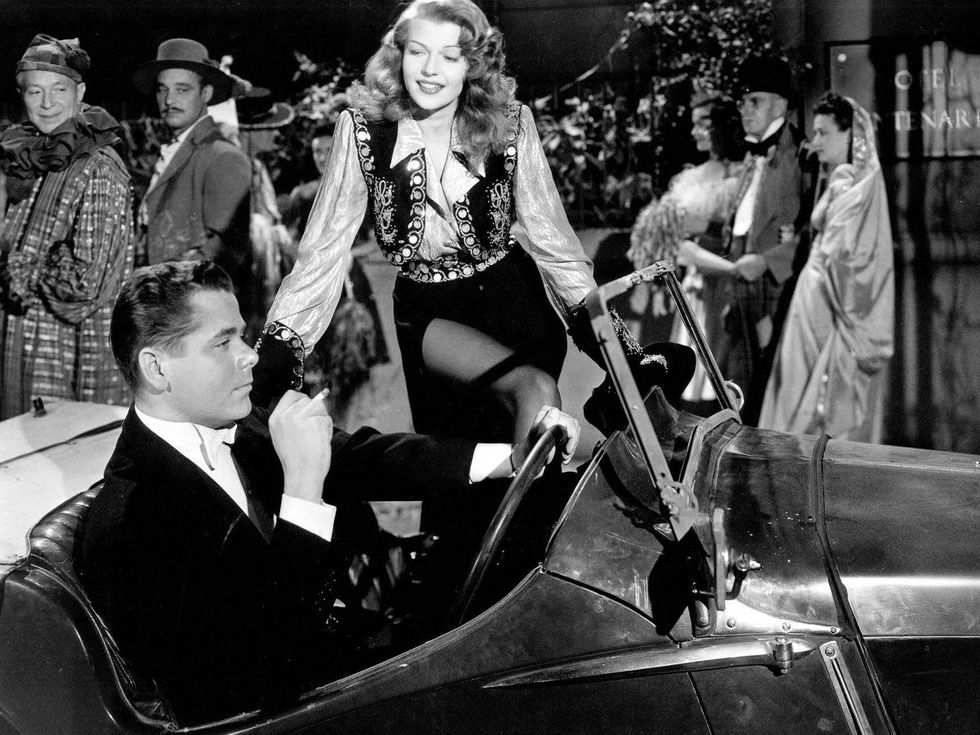
    The latter description certainly fits Johnny Farrell, the scruffy expat gambler played by Glenn Ford, during the opening scenes of Gilda. When we first meet Johnny, he’s slumming on the mean streets of mid-’40s Buenos Aires, cheating at illegal dice games – and not doing such a great job of disguising his chicanery. Indeed, Johnny is on the verge of being beaten by a sharper-than-expected sore loser when spiffy-dressing casino owner Balin Mundson (George Macready) passes by. Sporting an air of bemused authority, and wielding a blade-tipped cane that is equal parts phallic symbol and running joke, Mundson quickly dispatches the troublesome ruffian – and winds up offering Johnny a job as his personal assistant.

    Cut to Gilda, clad in a slinky dressing gown, flipping her hair and flashing an impudent smile as her face rises into the frame. Her coyly quizzical reply: “Me?”

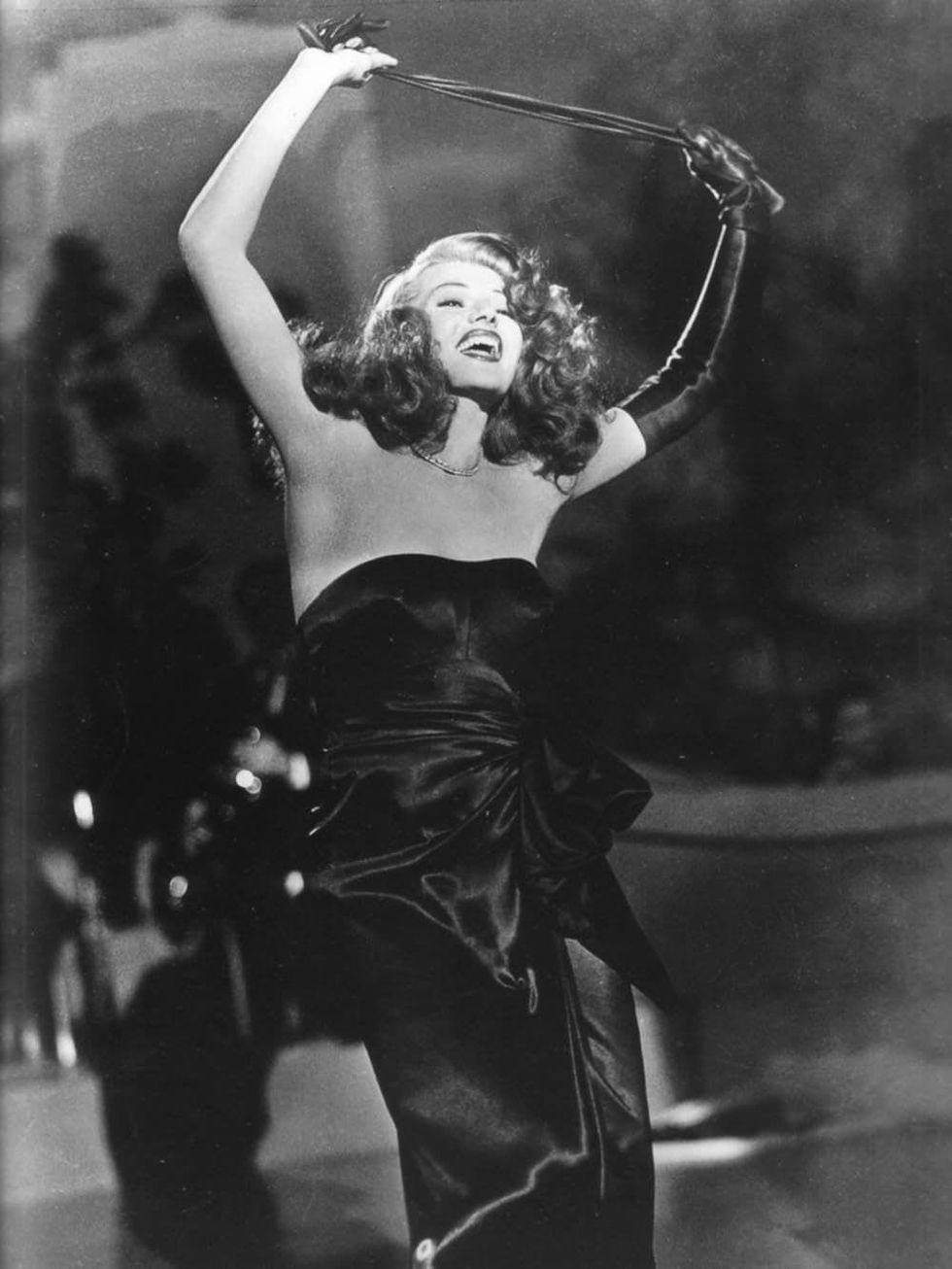
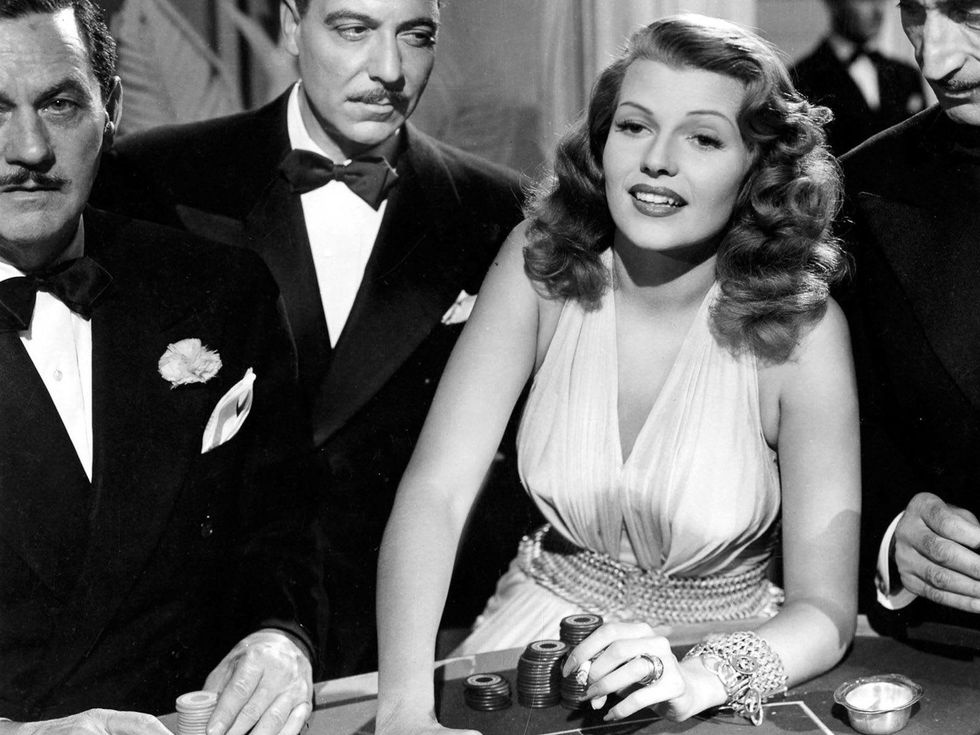
    We learn just how personal this assistance will be when Mundson introduces Johnny to his hot young wife, Gilda (Rita Hayworth at her most va-va-voom voluptuous), whose brazen naughtiness is evident from the moment she first appears on screen. Before entering the master bedroom with Johnny in tow, Mundson calls out: “Are you decent?”

    Cut to Gilda, clad in a slinky dressing gown, flipping her hair and flashing an impudent smile as her face rises into the frame. Her coyly quizzical reply: “Me?”

    But that smile fades fast from Gilda’s face when she sees Johnny, who in turn appears every bit as unpleasantly surprised.

    Right away, it’s obvious – if not to Mundson, then to any reasonably sentient person watching the film – that these two crazy kids were something of an item not so terribly long ago. And while we never learn all the messy details about their break-up, there’s no doubt that the affair ended badly. Which, of course, makes it more than a little awkward for both of them when Mundson – who’s either spectacularly clueless, or sadistically control-freakish, or both – gives Johnny the task of “keeping an eye” on his hot-to-trot spouse while he tends to business concerns.

    Nothing good comes of this.

    Psychosexual tension

    Gilda – smoothly directed by Charles Vidor (who previously worked with Hayworth on Cover Girl, and later re-teamed with her and Ford on The Loves of Carmen) and photographed by Rudolph Mate (who went on to direct the classic film noir D.O.A.) – has something to do with Mundson’s efforts to maintain an illegal monopoly on tungsten, and something else to do with German investors who are unhappy about their dealings with the casino owner. But the primary focus of the film is the perversely psychosexual tension between Johnny and Gilda, who do their damnedest to convince themselves, and each other, that they hate each other’s guts, even as they generate enough erotic tension to generate electricity for thriving suburb.

    At one point, Johnny – serving as the movie’s narrator, a role often filled by film noir protagonists – bitterly proclaims: “I hated her so, I couldn’t get her out of my mind for a minute.” At another point, Gilda snaps: “I hate you so much that I would even destroy myself to take you down with me. I hate you so much, I think I’m going to die from it.”

    Yeah, sure.

    Like many other noir melodramas, Gilda manages a shrewd end-run around restrictions dictated by the Production Code through scenes that are cleverly implicit rather than graphically explicit – thereby making the illicit behavior of key characters seem all the more depraved.

    Time and again, Gilda sexually taunts Johnny by, ahem, flirting with total strangers whenever Mundson’s not around. Johnny: “Doesn’t it bother you at all that you’re married?” Gilda: “What I want to know is – does it bother you?”

    (Even Mundson can’t help eventually noticing that there’s something going on between his attractive wife and his trusted employee. When he sees the audacious outfit she plans to wear for a carnival celebration, he inquires, only half-jokingly: “I see you’re going to carry a whip. Have you warned Johnny, so he could also arm himself?”)

    It all leads up to the movie’s most famous scene, when Gilda – more determined than ever to humiliate Johnny – does a steamy on-stage song-and-dance rendition of “Put the Blame on Mame” while hormonally inflamed male members of her audience hoot and holler their full-throated approval. Johnny, not surprisingly, gives her performance a thumbs-down review.

    As I said: Gilda has what might be considered – by noir standards, at least – a happy ending. But only if you don’t think too much about it. Because, really, it’s difficult to believe there’s too much happily-ever-aftering in store for this damned duo.

    To put it another way: Can you really imagine a lifetime of domestic bliss for the characters played by Cary Grant and Ingrid Bergman in Notorious (a movie released, not incidentally, the same year as this one) after the closing credits?

    If not – well, then maybe then you’ll agree with me that Gilda is genuine, 24-karat noir, in all the ways that matter most.

    Gilda (Rita Hayworth) at her most va-va-voom voluptuous, whose brazen naughtiness is evident from the moment she first appears on screen
    MFAH film series Femme Fatales The Women of Film Noir Aug. 2013 Rita Hayworth in Gilda
    UnitedArtists.Tumblr.com
    Gilda (Rita Hayworth) at her most va-va-voom voluptuous, whose brazen naughtiness is evident from the moment she first appears on screen
    unspecified
    news/entertainment

    Movie Review

    Glen Powell stumbles in remake of  sci-fi classic The Running Man

    Alex Bentley
    Nov 14, 2025 | 12:30 pm
    Glen Powell in The Running Man
    Photo courtesy of Paramount Pictures
    Glen Powell in The Running Man.

    For all its cheesy ‘80s greatness, the original version of The Running Man starring Arnold Schwarzenegger was a very loose adaptation of the novel by Stephen King. For the new remake, writer/director Edgar Wright has tried to hue much closer to the story laid out in the book, a decision that has both its positive and negative aspects.

    Glen Powell takes over for Schwarzenegger as Ben Richards, a family man/hothead who can’t seem to hold a job in the dystopian America in which he lives. Desperate to take care of his family, he applies to be on one of the many game shows fed to the masses that promise riches in exchange for humiliation or worse. Thanks to his temper, Ben is chosen for the most popular one of all, The Running Man, in which contestants must survive 30 days while hunters, as well as the general population, track them down.

    Given a 12-hour head start, Ben earns money for every day he survives, as well as every hunter he eliminates. Since he only has a relatively small amount of money to use as he pleases, Ben must rely on friendly citizens who are willing to put their own lives on the line to help him. That’s a task made even more difficult as the gamemakers, led by Dan Killian (Josh Brolin), use advanced AI to manipulate footage of Ben to make him seem like a guy for which no one should root.

    Co-written by Michael Bacall, the film is shockingly uninteresting, working neither as an exciting action film, a fun quippy comedy, or social commentary. The biggest problem is that Wright seems to have no interest in developing any of his characters, starting with Ben. Our introduction to the protagonist is him trying to get his job back, a situation for which there is little context even after we’re beaten over the head with exposition.

    The situation in which Ben finds himself should be easy to make sympathetic, but Wright and Bacall speed through scenes that might have emphasized that aspect in favor of ones that make the story less personal. The filmmakers really want to showcase the supposed antagonistic relationship between Ben and Dan (and the system which Dan represents), but all that effort results in little drama.

    Ben has a number of close calls, and while those scenes are full of action and violence, almost every one of them feels emotionally inert, as if there was nothing at stake. It doesn’t help that Wright doesn’t set the scene well, making it unclear how far Ben has traveled or who/what he’s up against. There are times when Ben feels surrounded and others when he can walk freely, weird for a society that’s supposed to be under almost complete surveillance.

    Powell has been touted as a movie star in the making for several years following his turn in Top Gun: Maverick, but he does little here to make that label stick. With no consistent co-star thanks to the structure of the story, he’s required to carry the film, and he just doesn’t have the juice that a true movie star is supposed to have. Nobody else is served well by the scattershot film, including normally reliable people like Brolin, Colman Domingo, Michael Cera, and Lee Pace.

    The Running Man is a big misfire by Wright and a blow to Powell’s star power. On the surface, it has all the hallmarks of an action thriller with a side of social commentary, but nothing it does or says lands in any meaningful way. Schwarzenegger’s one-liners in the original film may have been goofy and over-the-top, but at least they made the movie memorable, which is way more than can be said of the remake.

    ---

    The Running Man opens in theaters on November 14.

    moviesfilm
    news/entertainment
    Loading...