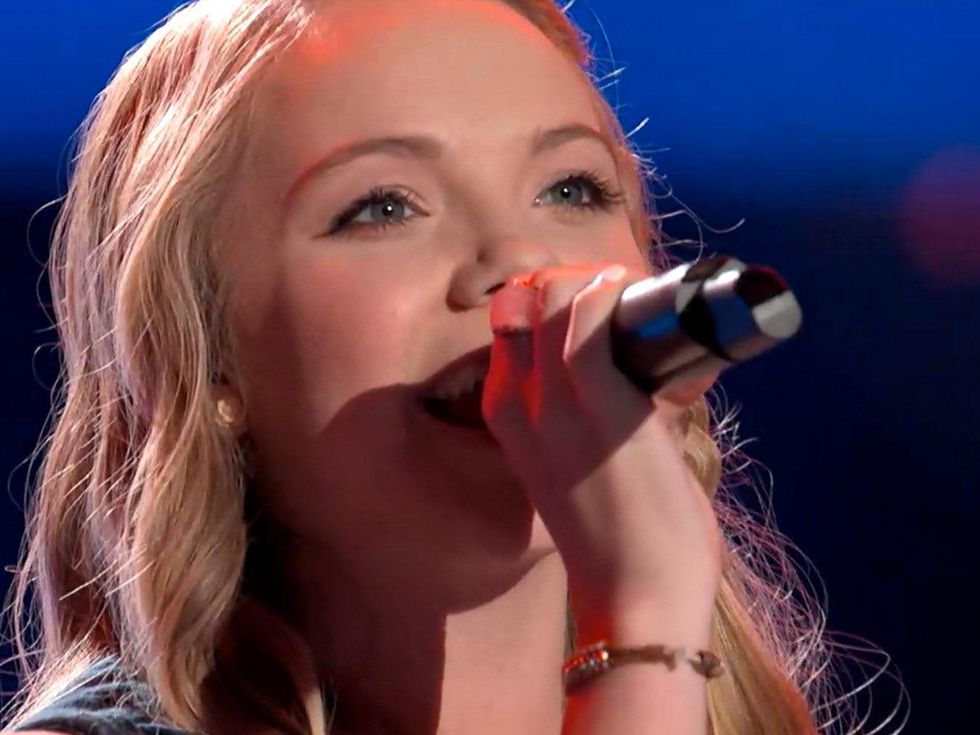
Sugar Land native Savannah Berry brought down the house during Tuesday's blind auditions on The Voice, joining Cypress' Danielle Bradbery as the season's second Houston-area contestant to effortlessly earn a spot on Team Blake.
Taking on the Taylor Swift/Civil Wars hit "Safe and Sound" from The Hunger Games, the 17-year-old country singer had Adam Levine pressing his "I Want You" buzzer just seconds into her performance. Shakira and Blake Shelton chimed in moments later.
"What I heard was something that couldn't be ignored," gushed Levine after the song.
"What I heard was something that couldn't be ignored," gushed Levine after the song, desperately fighting off his fellow judges with the claim of being the first to pick her.
But like Bradbery last week — and Baytown firecracker RaeLynn in season two — Berry stayed true to her countrified roots by choosing to work with Nashville giant Blake Shelton, who said he was "fascinated" by her voice.
More than 100 fans, friends and family members flocked to Bee's Creek Grill in Missouri City on Tuesday to watch Berry perform.
"We're so thankful for all the friends and family that have come out to support Savannah over the years who have always been here," the singer's mother Shelly Berry told KPRC Ch. 2, adding that she knew her daughter was destined for stardom since she first sang in from of her elementary school as a kindergartner.
Check out Houston's newest country talent below and be sure to tune into The Voice on Mondays and Tuesdays on NBC to follow their battle to the top.
Berry joins Cypress' Danielle Bradbery, pictured, as the second of two Houston-area contestants on the popular singing contest.
NBC.com
Berry joins Cypress' Danielle Bradbery, pictured, as the second of two Houston-area contestants on the popular singing contest.
Andrew Garfield and Julia Roberts in After the Hunt.
The #MeToo movement was at its peak during the late 2010s, with high profile people in the entertainment industry and elsewhere starting to be held accountable for prior sexual assaults and/or sexual harassment. A few movies, like The Assistant and Bombshell, confronted the issue while it was still garnering headlines, making the films themselves feel even more important.
The new film After the Hunt seems to have an appropriate title, as it’s a fictional look back at the culture during that time from the perspective of the current day. Alma Imhoff (Julia Roberts) and Hank Gibson (Andrew Garfield) are professors at Yale University in the same department. They are both very friendly with Alma’s TA, Maggie Price (Ayo Edebiri), even inviting her and other students to Alma’s home for boozy gatherings.
That friendliness and booziness comes to a head when Maggie confides to Alma that Hank “crossed the line” after walking her home one night. Alma, whose history with Hank is more than just professional, finds herself in a battle between believing what Maggie is telling her and standing up for her longtime friend. The tight group slowly gets pulled apart as each of them and people around them grapple with the fallout of the accusation.
Directed by Luca Guadagnino and written by first-time screenwriter Nora Garrett, the film’s solid premise soon gives way to the disease of bloat. The overly-long 138-minute movie isn’t satisfied with the dramatics of its central plot, instead adding on a number of character quirks that either add nothing to the story or do little to enhance it. These include a mysterious ailment for Alma that gives her intense stomach pain, her somewhat strained marriage to Frederik Mendelssohn (Michael Stuhlbarg), and Maggie’s relationship with a transgender man.
The filmmakers make the choice to not show a number of key moments, like the actual incident between Maggie and Hank or when Hank finds out he’s been accused. The scenes they do include, like charged one-on-ones between Maggie and Alma or Alma and Hank, work well, but the film loses all momentum when it digresses into other areas. As consequences start to be felt, it’s almost as if Guadagnino and Garrett stop caring about the main plot at all, with the main characters devolving in a number of ways.
More than anything else, the film never has anything interesting or new to add to the #MeToo conversation. Instead of a tight, taut drama about how the three main characters deal with their feelings about the incident/accusation, the story meanders aimlessly. Garrett also seems to want things both ways, casting doubt on Maggie while also giving her a righteous cause. The result is a muddled mess with nobody coming off as compelling.
That clutter extends to the casting, with the 57-year-old Roberts portrayed as a contemporary with the 42-year-old Garfield. The film never adequately explains their relationship, leaving audiences to fill in gaps they shouldn’t have to bridge. Roberts, Garfield, and Edebiri are each fine actors who do good work in their roles, but the story does them no favors.
Just because it’s disappeared from the headlines doesn’t lessen the importance of the #MeToo movement, but if After the Hunt was trying to revive it in some way, it fails in that ambition. Its star power is mostly wasted in a story that never seems as interested in its main idea as it should be.